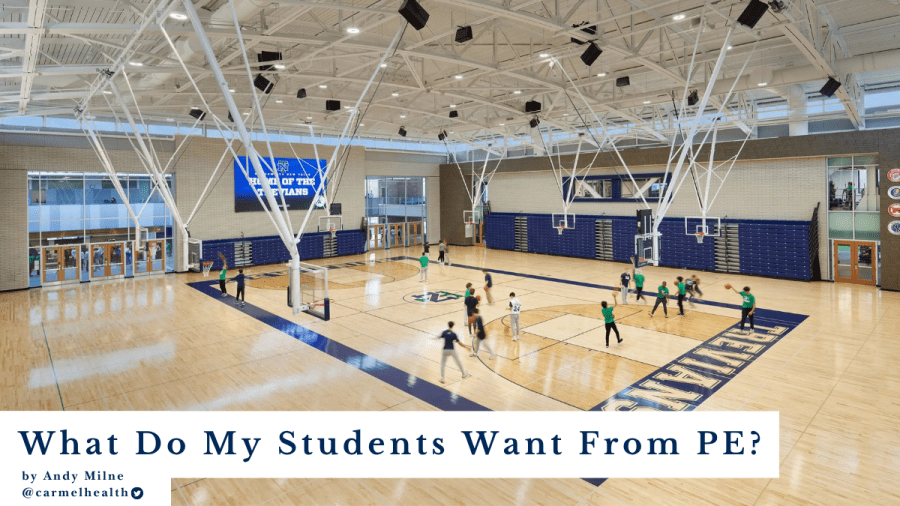
As excited as I am to start the new school year with a new cohort of students, I have to remind myself to slow down before diving into content so that I can get to know who I’m dealing with. While teachers are learning names, asking about interests, and understanding the personalities in front of us, it’s also important for me to ask students what they want from their physical education experience.
Regular readers of the blog will know that we offer junior and senior students a significant number of PE electives at my school, ranging from dance to outdoor activities, yoga to strength and conditioning, team block to lifetime activities. The latter is my elective, a class that focuses on breadth more than depth, cooperation more than competition. I have a range of students from prospective D1 athletes to students yet to find a favorite way to move.
Following on from the success of last year’s start to semester 1, I repeated a reflective assignment that asked students to think about their previous experiences of PE and relationship with physical activity:
Reflect on your past experiences in PE or any physical activities. What did you enjoy the most, and what made those moments stand out? Consider what makes an activity fun, challenging, or meaningful for you. What would a PE program need to include to ensure that every student has a positive experience and begins to appreciate the value of physical activity? Think about things like how activities are organized, who you get to work with, and how you feel when you’re participating.
I deliberately didn’t explain what I meant by meaningful, as I wanted students to interpret that word for themselves.
After writing their reflections, students turned their cards over and were asked to underline the six words they considered most important. Finally, they wrote a sentence incorporating all six words.
This assignment took about 10 minutes to complete, and presented me with a bank of student reflections that I can return to and read individually, but also a collection of words representing what this particular cohort values most.
Finding the patterns
I typed the selected words into ChatGPT exactly as the students had given them and asked it to summarize the responses. I informed students that I would be doing this as I believe that teachers should be transparent about when and why we are using AI.
The analysis revealed some clear patterns.
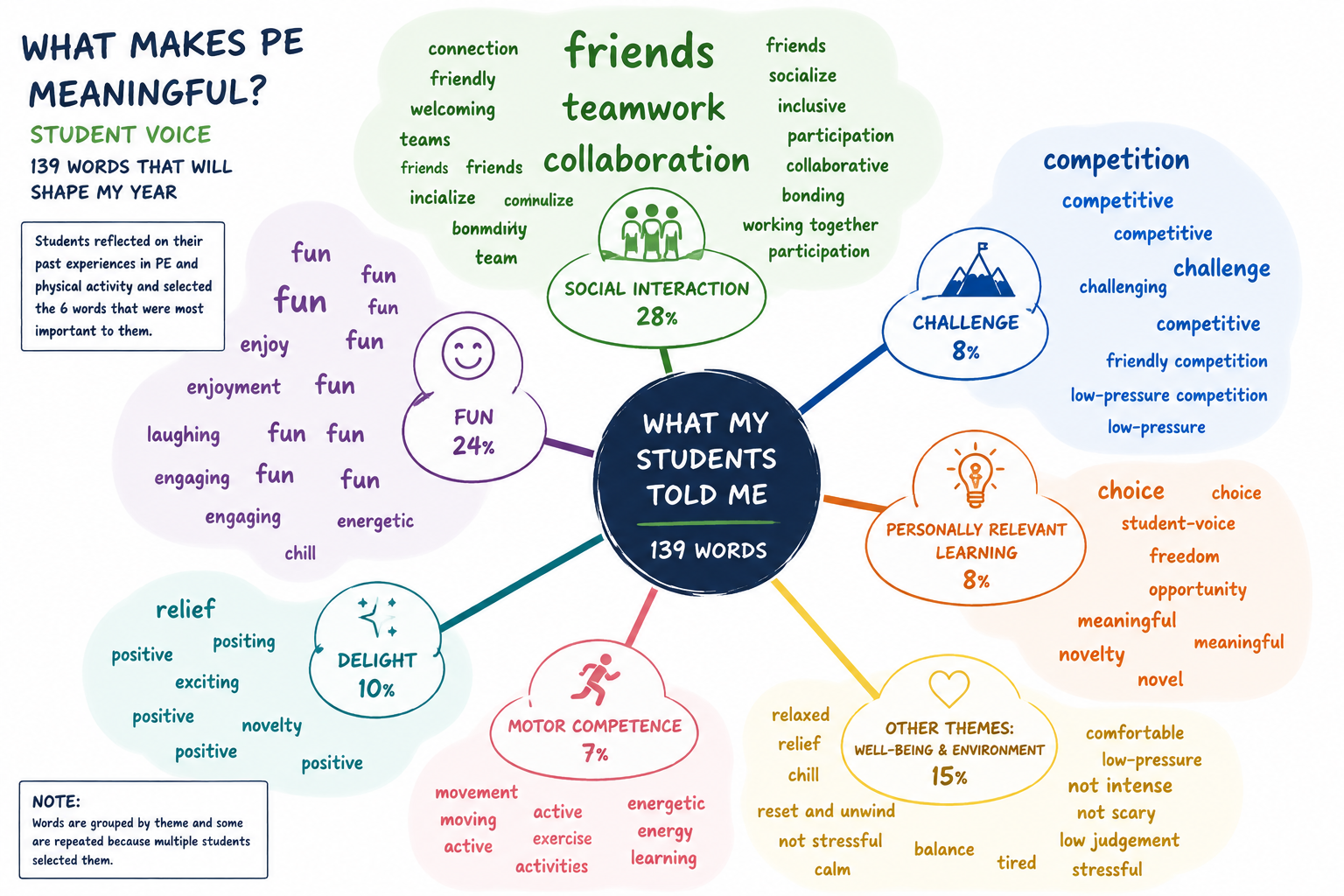
Social interaction was the strongest theme, accounting for approximately 28% of the responses. Students repeatedly selected words such as friends, teamwork, collaboration, welcoming, inclusive, bonding, and community.
Next came fun, at approximately 24%. The word fun alone appeared 23 times, alongside enjoy, enjoyment, play, laughing, and engaging.
Other responses pointed towards challenge, motor competence and personally relevant learning. Competition appeared frequently, while students also talked about movement, being active, exercise, choice, freedom, opportunity and student voice.
If you are familiar with the Meaningful Physical Education framework, those themes will sound familiar, but they won’t to my students. This early in the year, I haven’t introduced my students to the language features of Meaningful PE: social interaction, fun, challenge, motor competence, personally relevant learning and delight.
Instead, I took their language and looked for connections to the MPE framework. As the year progresses, I can gradually introduce the appropriate MPE terminology and help students make those connections themselves.
They already know that they value friends, teamwork and bonding. I can help them recognize social interaction, and create socially safe environments that include and respect all students.
They know they want choice and freedom. We can explore personally relevant learning and co-construct our curriculum.
They tell me they value competition and being challenged. We can investigate what an appropriate level of challenge looks like, sounds like and feels like, finding a challenge that is ‘just right’.
Rather than starting with a framework and telling students what makes physical education meaningful, I’m starting with their experiences and giving them language with which to understand them.
What about the words that didn’t fit?
During my initial journey into Meaningful PE, I thought that the 6 features were ‘official’, exhaustive, complete. A Meaningful Podcast Experience episode with Steph Beni reminded me that wasn’t the case.
I think we’ve been super intentional and clear about this—that we never wanted it to be, “These are the features of meaningful experiences, and that’s it,” never like an exhaustive list.
From the time we published that review and through all the research that we’ve done since then, we’ve always wanted teachers to feel the freedom and the importance of adapting that to their own context and using language that works with their students.
And if there’s a feature in that list that doesn’t work for the students, take it out. If there’s one that needs to be added, add it.
Some of my students’ most interesting responses were those that I couldn’t easily shoehorn into one of the six MPE features.
Students wrote relaxed, relief, chill, reset and unwind, not stressful, calm, comfortable, low-pressure, not intense, not scary, and low judgement.
Collectively, those words seem to say something important, and perhaps explain why my students chose this specific elective.
My students aren’t necessarily asking for PE without competition or challenge. In fact, competition appeared repeatedly. They seem to be asking for opportunities to experience those things in an environment that also feels safe, welcoming and low-pressure. School can be quite stressful for my students – juggling academic workload, extra-curricular commitment, plus the demands of friends and family. Some of my students see my class as a break – not a break from learning, but a break from academia, and I fully embrace that.
Why do this at the start of the year?
Every new cohort is different. We can enter the year with established units, successful lessons and carefully written curricula, but the students experiencing those lessons have changed. This simple activity gives me an early glimpse into what these students value.
It doesn’t mean that my curriculum suddenly becomes a popularity contest or that I only teach activities students already enjoy. Student voice doesn’t have to mean student control. What it does mean is that I can make more informed decisions about how I organize activities, create groups, provide choice, frame challenge and build the learning environment. As Doug Gleddie has said on a few occasions, it’s not fair for my students to experience the ‘same stuff, different day’.
My next step is to go back through the student responses and look beyond the six selected words. I’ll read the students’ sentences and reflections, looking for individual comments that add depth to the patterns ChatGPT identified. I’ll then share the findings, and this post, with my students.
This assignment has me fired up for yet another (my 31st) school year. I wish you all the best for the school year ahead also.
If this blog post has inspired you to read more on making PE more meaningful then you’ll like the following:
Meaningful PE: Autobiographical Assignment by Andy Milne
Making Meaningful Physical Education Elementary Friendly by Will Westphal
The Power of Meaningful and Joyful Experiences by Leticia Cariño
Buy the book! Meaningful Physical Education by Tim Fletcher, Déirdre Ní Chróinín, Doug Gleddie, and Stephanie Benni
Check out this Spotify playlist of podcast episodes discussing Meaningful PE, which includes the awesome podcast project from Doug Gleddie and Ty Riddick.


Pingback: Making Space for Delight – #slowchathealth