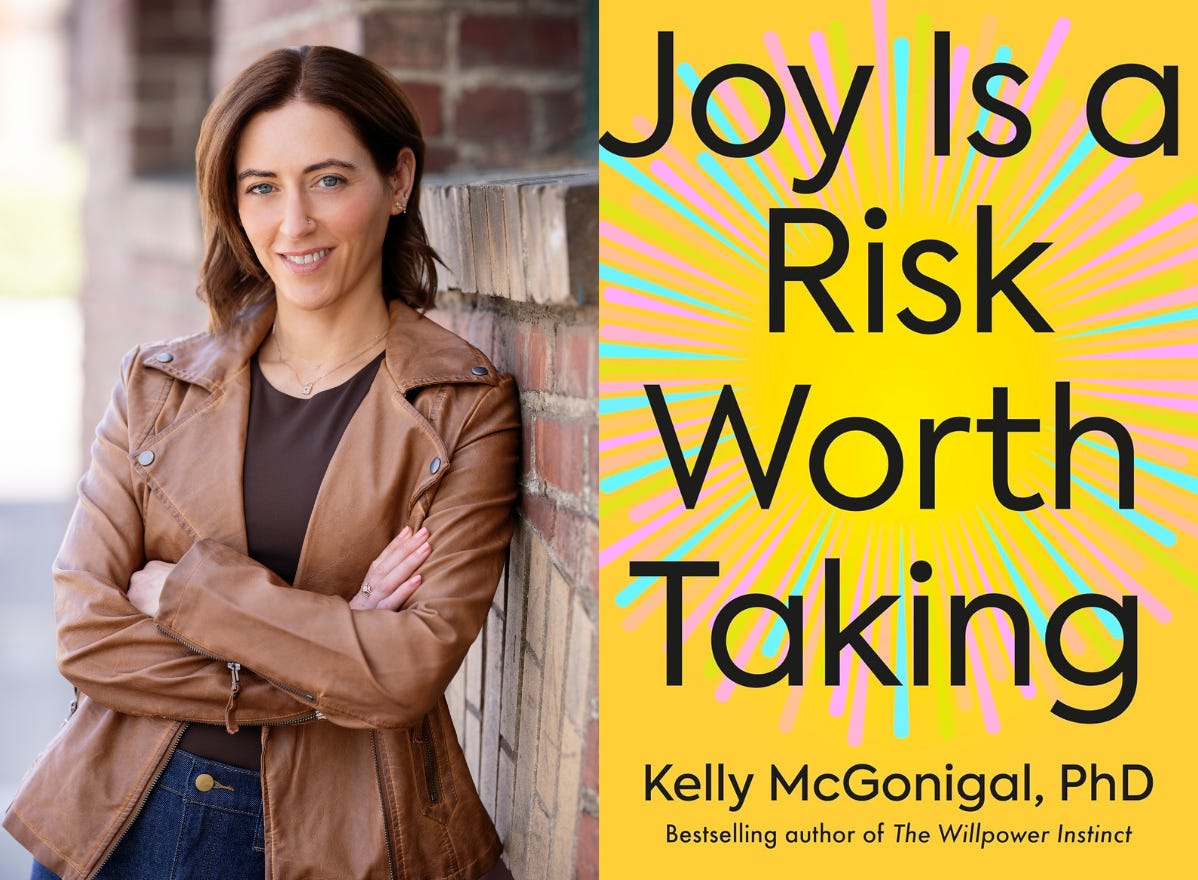
It might be my age, or the time of year, or the economy, or the state of politics at home and across the world, but I’ve been feeling flat. I’ve been feeling joyless, and have promised myself that I would do something about it, for myself, and for those around me. For that reason, the recent release of Dr. Kelly McGonigal’s new book, Joy Is a Risk Worth Taking, piqued my interest and seems to have come at just the right time.
In her book, McGonigal redefines how we understand one of our most coveted emotional states. While many of us treat joy as a rare, passive emotion that arrives only when life goes according to plan, she presents joy as a dynamic, neurobiological response system designed to keep us engaged with life, connected to others, and hopeful about the future.
The book confirms what I had suspected – that joy requires vulnerability and an element of courage is needed to actively seek out joy. McGonigal frames joy as a “risk worth taking” and seeking it requires lowering our defenses and caring deeply about the world despite the potential for pain. To help us cultivate this state, McGonigal suggests 20 practical “Joy Experiments.” One experiment in particular caught my attention:
Capture your micro-uplifts. For one week, create a record of things that bring you joy.
A micro-uplift is a brief event, a warm laugh, a flash of gratitude, or a favorite song, that signals to the nervous system that life is good and safe. While a single uplift lasts only seconds, frequently registering them reshapes your baseline state into an enduring reservoir of resilience. Those of you familiar with Deb Dana and Polyvagal Theory, might refer to these as a glimmer. The theory behind noticing micro-uplifts, is that not only does this shift your nervous system into a calm, regulated state, but that it also trains your brain to notice joy, creating the emotional baseline necessary to experience deeper joy and happiness. McGonigal refers to this as lowering our joy threshold.
Determined to break out of my slump, I decided to run a joy experiment myself. For seven days I logged my daily micro-uplifts across my work as an educator and in my personal routine. Here is what I witnessed and how each day reflected McGonigal’s research:
Day 1: My week began on the morning commute listening to Kotoa’s Out of the Dark EP, feeling an immediate sense of light and hope. Their music has a joy that is much needed in these times. Upon arriving at school, a colleague brimming with excitement over the Milwaukee Brewers reaching the World Series greeted me, leaving me with a lasting smile. Later that morning, I ran into a retired co-worker back in the building as a substitute teacher. This was a nice moment of reconnection in the often transient world of education.
The McGonigal Connection: Day 1 highlighted embodied joy and emotional contagion. Music, as it often does for me, acted as an auditory bridge that primed my nervous system for hope before the workday started. The shared sports excitement illustrated collective joy, showing that joy is inherently social and contagious. Finally, the surprise reunion tapped into meaning-based joy, proving that allowing ourselves to care deeply about relationships creates profound warmth amidst everyday transience. Relationships will become a key feature of the week ahead, reminding me to get out of my office more, and consider the role that I can play in bringing joy to others.
Day 2: A senior student walked past me in the hallway and asked his daily question: “On a scale of 1–10, how’s your day going so far?” This interaction originated two years ago in my sophomore health class, adapted from an exercise in Jane McGonigal’s book SuperBetter. Seeing him still use it as a senior made my day.
The McGonigal Connection: This moment captured a reciprocal loop of connection. By turning a health class exercise into a daily ritual, the student actively forced a brief pause in my day to scan for goodness. I appreciate that this ‘Plus-One Better Quest‘ bridges the philosophies of the McGonigal sisters – using small, intentional games (SuperBetter) to tune our neurobiology toward connection and joy (Joy Is a Risk Worth Taking).
Day 3: During morning advisory, my student advisees gave a presentation on the work they do giving up free periods to tutor peers in our Academic Assistance Center. Before school, I had written and mailed a supportive postcard to a teaching friend in Minnesota who was starting a new long-term sub position. These postcards are a tradition of mine and although I’ve been writing them for many years….I don’t think I’d taken the time to consider how joyful this act really can be.
The McGonigal Connection: Day 3 demonstrated prosocial and generative joy. Watching students step up for their peers triggered what psychologists call moral elevation, (and others might call the feels), a warm, uplifting feeling that restores faith in community goodness. Meanwhile, sending a physical postcard showed that joy isn’t just passively received; actively generating goodwill outward releases oxytocin and creates a “helper’s high.” This is one of the reasons why I teach students how to craft the perfect thank you.
Day 4: To wrap up a mental health unit, I wore a pale yellow hoodie with positive mental health themed graphics, stepping out of my standard PE “uniform” of technical athleisure wear. Later in the day, walking through a wing of our building with large glass windows, I caught light refracting into small rainbows across the hallway.
The McGonigal Connection: Wearing the bright hoodie was an act of embodied expression and vulnerable joy, stepping outside my comfort zone to visually represent the message I was teaching. Spotting the refracted rainbows tapped into sensory wonder, showing how brief encounters with natural light calm the nervous system and signal safety. It’s not uncommon to see these refractions in our building and they ALWAYS make me smile.
Day 5: Friday saw two social media rituals that brought me joy. First, watching Owen Cutts’ “Old Music Friday” Instagram breakdown, a predictable morning routine that signals the end of the week. Then, after a heavy week of discussions in advisory, a junior boy suggested we lighten the mood with Friday morning karaoke. I brought in my karaoke machine, and five groups of teen boys stood up to sing. To watch high school boys drop their guard, embrace vulnerability, and cheer each other on while singing (mostly out of tune) was the absolute highlight of my school week. Finally, at 3:30 PM, I carried out my own weekly tradition: posting an “artsy” photo taken around the building with the caption “closes laptop until Monday.”
The McGonigal Connection: Day 5 brought together vulnerable play, collective effervescence, and anchor rituals. The Friday karaoke session captured McGonigal’s core thesis: joy requires dropping our defenses. In a culture where teenage boys often face pressure to stay guarded, choosing to sing together created a profound state of social safety and shared joy. Meanwhile, my 3:30 PM photo ritual established a firm work-life boundary while training my brain to scan the school environment for artistic angles and light all week long.
Day 6: On Saturday, I took the step of muting three news-heavy Instagram accounts that frequently triggered anxiety about world events. Taking control of my feed left me feeling proud and empowered.
The McGonigal Connection: Experiencing joy requires protecting your capacity for joy. By muting anxiety-inducing accounts, I lowered my baseline threat response, clearing out digital noise so quiet micro-uplifts could be felt. Realizing that six days into my experiment I was actively scanning for joy proved that my brain’s detection threshold was already lowering. I was starting to become more tuned into joyful moments.
Day 7: On Sunday morning, I woke up early while the family was still asleep. I brewed fresh coffee, made slow-cooked oatmeal, and sat down to read a book in the quiet house. Carving out this intentional, unhurried morning ritual on weekends feels like an investment in myself – a moment where I take control of my own time rather than being beholden to commute schedules and school bells.
The McGonigal Connection: This final entry captured restorative agency and intentional presence. In McGonigal’s framework, joy requires feeling safe enough in our own lives to slow down and savor the present moment. By stepping off the clock-driven pressure of the workweek and reclaiming personal time, quiet self-care creates an internal reservoir of peace that prepares the mind and body for the week ahead.
If you feel like joy is something you have to wait for, I challenge you to try Kelly McGonigal’s experiment for just one week. Within a few days I found myself actively looking out for joyful moments, and sitting with them as opposed to just moving on with my day. Once the week was over I found myself sharing my findings with others, not only because I was proud of having conducted such an experiment, but also because I wanted them to experience the joy that I had.
You don’t need to wait for significant milestones or perfect conditions. Simply write down 1 to 3 tiny moments each day that bring a flash of lightness, connection, or appreciation. You’ll quickly find that joy isn’t missing from your life, your brain just needed a reason to lower its threshold and start noticing it.
I’d love to hear what micro-uplifts you experienced this week!
If you liked this post, you’ll also appreciate the following:
The Joy of Movement by Kelly McGonigal. I absolutely LOVE this book!
Choose Joy by Sophie Cliff. There’s even an accompanying Sprinkles of Joy card deck that would make a great gift!
The Happiness Boomerang by Dale Sidebottom

