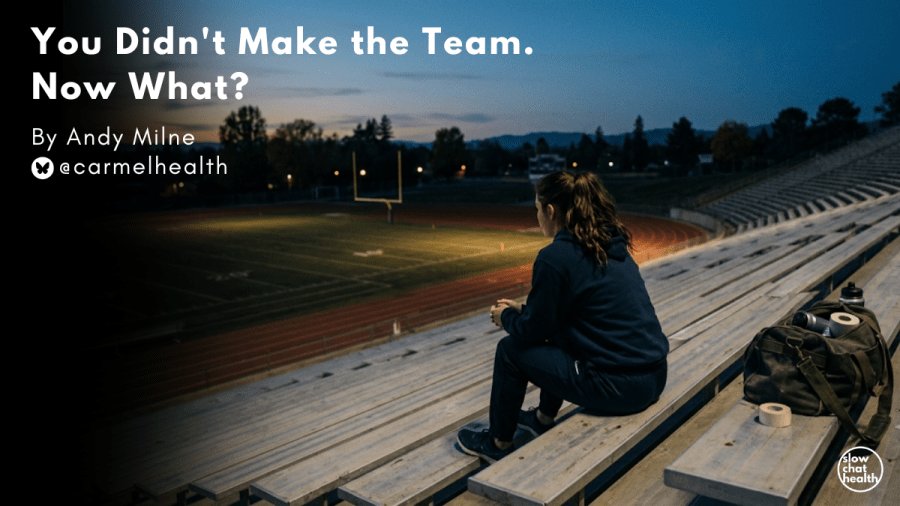
Let’s get over the awkwardness straight away. If what brought you to this blog post was disappointment at not making the team that you really hoped you would make, I’m sorry. Regardless of the situation, that’s not a nice feeling, and I know it hurts. I’ve been there, as a player and a coach. Being cut is disappointing. It can leave you questioning your ability, your future, and even yourself.
If that’s where you are today, I hope you’ll find something in this post that speaks to you.
It’s OK to be disappointed.
You don’t have to pretend you’re okay. Missing out on something you’ve invested your time, energy, and heart into should hurt. Give yourself permission to feel frustrated. “If your first reaction is sadness, anger, embarrassment, or confusion, that doesn’t mean you’re weak” (1). It means you cared. Those emotions are a natural response to disappointment.
Just remember that feelings are temporary. They deserve to be acknowledged, but they don’t have to make your next decision for you.
Don’t confuse a roster decision with your identity.
For many athletes, sport becomes part of who they are. You aren’t just someone who plays volleyball or soccer or basketball. You’re the volleyball player. The soccer player. The swimmer. That’s why being cut can feel so personal.
But here’s an important reminder: a coach made a decision about a team, not about your value as a human being. A roster is built around countless factors: positions, team balance, experience, chemistry, immediate needs, and future potential. Sometimes the decision has very little to do with effort or character.
You are still the same awesome person you were before the roster was posted.
Your friend’s success is not your failure.
This can be one of the hardest parts. Your friend/neighbor/club teammate/training partner made the team, and you didn’t.
It’s okay if that stings, but don’t let disappointment turn into resentment. Your friend’s success didn’t cause your disappointment. They didn’t take something away from you. This is their moment, and they deserve to enjoy it without feeling guilty.
Celebrate them if you can. If you’re not ready today, that’s okay too. But don’t allow your disappointment to damage a friendship that matters. There will be times when they need you to cheer for them, just as there may be a day when they’ll be cheering for you.
Ask the right questions.
After being cut, it’s easy to ask questions like: “Why wasn’t I good enough?” or “What’s wrong with me?”
Those questions rarely lead anywhere helpful. Instead, try asking:
- What skills do I need to improve?
- What feedback can I ask my coach for?
- What can I control between now and my next opportunity?
- What did I learn about myself during this process?
Those questions shift your focus from blame to growth.
Turn rejection into information.
Being cut doesn’t automatically make you stronger, but what you do next might. Some athletes allow rejection to convince them they’re finished, they’re quitting. Others allow it to sharpen their focus. “Take being cut as an opportunity to evolve, rather than seeing it as the end of your athletic career.” (2)
Maybe this becomes the offseason where you commit to getting stronger. Maybe you improve your fitness, develop your weaker skills, or spend more time studying the game. Don’t train to prove someone wrong, train to become a better player.
This one moment doesn’t define your story.
Every athlete admires perseverance when they see it in someone else.
The comeback. The unexpected breakthrough. The athlete who wasn’t selected the first time but kept working until they couldn’t be ignored. These stories are memorable and there are many stories of famous athletes and their early setbacks.
During the 2026 soccer World Cup Dr. Jeremy Alland shared a great online post where he identified international players who had similar early career setbacks:
Harry Kane, England’s all time goal scorer was cut by Arsenal at the age of 8. He wasn’t behind on skill, he was behind on his growth spurt which came later than his peers.
French midfielder N’golo Kante was rejected at EVERY trial he had between the ages of 10 to 19. He played in the lower leagues until his skills caught up. Since then he has won the World Cup, the Champions League, and the English Premier League twice.
Erling Haaland played handball, golf, ran track and skiied before he eventually specialized in soccer. His records now include being the fastest player to 100 Premier League goals, most goals in a single Premier League season (36), and quickest to 50 UEFA Champions League goals.
Your chapter feels significant because you’re living it. It doesn’t have to be the final chapter. Every player is on a different journey, a different timeline. Dr. Alland says “The one who looks best right now might just be ahead on the clock, not ahead for good. The one who looks behind might just need more time.”
Keep your love of the game!
One of the greatest risks after disappointment is walking away from something you once loved. Don’t let one decision steal your joy. Continue to play, train with friends. Some may choose to volunteer, coaching younger athletes.
Stay connected to the sport if it still brings you happiness. Your relationship with your sport doesn’t have to end because one season didn’t begin the way you hoped.
Remember that there is more to you than your sport.
Being an athlete is something you do, it’s not all that you are.
You are also a friend, a sibling, a classmate, a leader, a musician, an artist, a volunteer, a student, and so much more.
Sport can shape your identity, but it should never become your entire identity, and it is athletes who maintain that perspective who often become more resilient when challenges arise because they understand that one disappointment cannot erase everything else that makes them who they are.
One final thought.
If today hurts, that’s understandable, and if you’re disappointed, you’re not alone. If you’re wondering whether you should even try again, give yourself a little time before answering that question. One coach’s decision on one day is exactly that: one decision on one day, and it’s definitely NOT a prediction of your future, or a measure of your worth.
The next chapter of your athletic journey hasn’t been written yet.
Resources:
- https://kids.frontiersin.org/articles/10.3389/frym.2022.702935
- https://www.coachup.com/nation/articles/bounce-back-recover-after-getting-cut
- https://www.progressionvolleyball.com/dear-cut-athletes-it-gets-better
- https://balanceisbetter.org.nz/coping-with-the-cut-what-parents-can-do-to-help/
You might also like the following:
How Toxic Teammates Hurt Performance by Andy Milne
5 Ways That Cell Phone Use Negatively Impacts Athletes by Andy Milne

