What if the thing holding back your strongest student work isn’t rigor — it’s the fact that you’ve assigned one product to thirty different people?
We spend a lot of time designing what students will learn. We spend a lot less time thinking about who gets left out when we also dictate exactly how they have to show it.
The Standard Is the Bar. The Format Is Not.
In skills-based health education, our non-negotiables are the performance indicators. That’s where rigor lives. Look at Standard 8 — advocacy. A student can write a letter to a congressperson, create an informational website, produce a podcast, design stickers, or launch a peer teaching campaign. Different vehicles, same I CARE framework, same rubric criteria. The skill expectation doesn’t move. The pathway to demonstrating it does.
That’s not an accident of design. That’s the point.
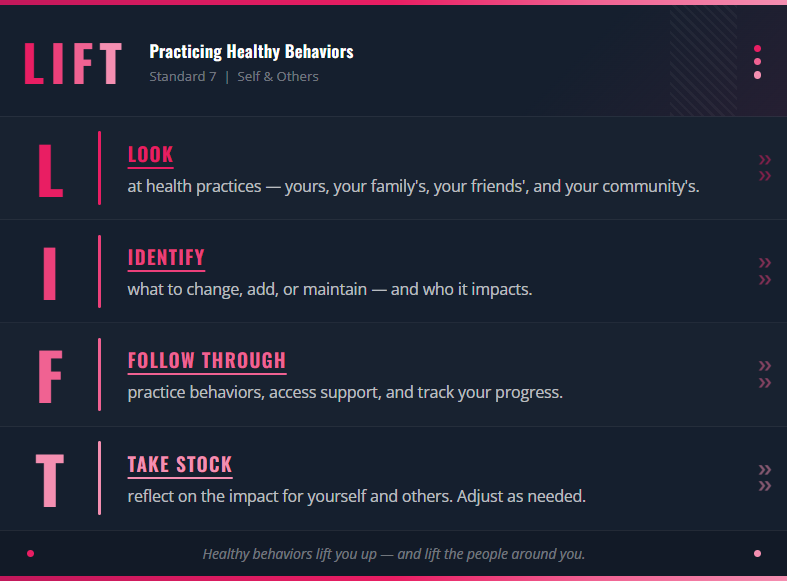
The same logic shows up in a mental health unit anchored to Standard 7. When the driving question is “How can we create and share strategies that help ourselves and others manage stress?” Regardless of format, every student is doing the same thing — Looking at health practices and needs, Identifying what to change or maintain, Following Through by practicing behaviors and accessing support, and Taking Stock of the impact on themselves and others. The Stress Management Toolkit, the Calm Zone proposal, the podcast episode — they’re just different ways of demonstrating learning.
The UDL Connection
UDL’s goal isn’t just that students can access a lesson. It’s learner agency — students who are purposeful, resourceful, and action-oriented. That maps almost perfectly onto what we’re trying to build in health class. When a student selects their advocacy medium based on genuine conviction about what will reach their audience, they’re not taking an easier path. They’re doing exactly what Standard 8 asks: acting passionately and with conviction, relaying a health-enhancing message to a real audience.
The Grading Question (Because You’re Thinking It)
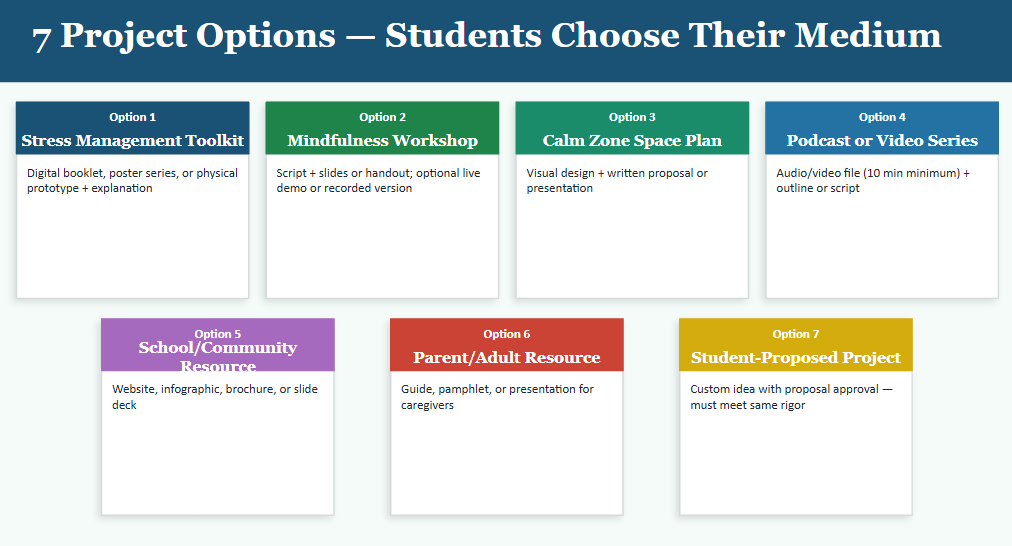
The most common pushback: “How do you grade different products fairly?” The answer is already in the design. In the Find Your Calm unit, every one of the seven project options is assessed against the same core skill — and the rubric doesn’t care whether you built a toolkit or recorded a podcast. It’s measuring whether the student demonstrated health-enhancing behaviors and reflected on the impact for themselves and others. The format is the vehicle. The skill cues are what you’re measuring.
If grading feels inconsistent across products, that’s a rubric design problem — not a choice problem.
The Bigger Picture
Real health decisions don’t come in one format. Students won’t get a multiple-choice question when they need to advocate for something they care about, manage stress in a real moment, or help someone find support. They’ll need to be resourceful and find a pathway that works in their context.
Teaching them to do that — and designing assessment that requires it — is the whole point.
Choice isn’t accommodation. It’s alignment.
This microblog post was a featured post in #slowchathealth’s #microblogmonth event. You can search for all of the featured posts here. Please do follow each of the outstanding contributors on social media (including Ian Lacasse the author of this post) and consider writing a microblog post of your own to be shared with the global audience of slowchathealth.com
Pair this post with the following:
UDL on the Slopes: Think of Your Class Like a Ski Resort by Amy Falls
‘Sticky Learning’ Strategies by Dr. Kim Morton