The majority of teens are using AI and they’re using it often. A common sense media survey found that “72% of teens have used AI companions at least once, with more than half using them a few times a month.” Even more, an NPR article goes on to say “nearly one in three teens use AI chatbot platforms for social interactions and relationships, including role playing friendships, sexual and romantic partnerships.” This means that our teens are turning to AI to solve real struggles they are facing in their lives and this should scare us. Our responsibility is to protect and care for our children and we are failing them by providing unfettered access to AI. We need to make a change. We should not be allowing access to an unregulated technology that has clear research demonstrating the harmful effects. I argue that AI use should be banned in K-12 schools and beyond. It’s imperative that we teach our students how to think critically and develop the skills required to keep themselves safe.
Our Brain, Cognitive Offloading, and Cognitive Surrender
Our brain’s working memory seems to only hold about 3-9 chunks of information at a time. Imagine you are teaching a student to shoot a basketball free throw for the first time. As the coach, you might first teach them foot placement, hand placement, and elbow placement. It would make sense to have them practice those three steps, to continually retrieve that information from their brain, and build the connections to their muscles. After some practice, you could then introduce the next ones: extension and follow-through. You’d then give the student time to practice those two new steps while still incorporating the earlier ones. This process is a fundamental understanding of how learning happens; providing time to play around with the information in our working memory to retain it in long-term memory. AI disrupts this process.
AI eliminates the effort required for this process to work. As a Psychology Today article states, “when information is acquired without mental effort, it tends to disappear just as fast. If it doesn’t take much to acquire, our brain often decides it isn’t worth holding onto.” If a student in our health class was trying to learn a new skill, they need to give their brain practice building new connections – just like building muscles. Without that practice, students could experience some “cognitive atrophy” where their brain experiences a functional decline in memory, reasoning, etc.
Now imagine you are having students write a response to a decision making scenario. Ideally, students would read through the scenario and write their response based on the cues they learned in class (i.e. D.E.C.I.D.E. steps). While they are writing, they would be taking the perspective of the reader, considering ethical dilemmas, reflecting on their own experiences, practicing analysis, applying skepticism, practicing empathy, and so much more . This simple act of writing is how the brain forms new pathways and stores the decision making steps. On the contrary, imagine that same student typing the scenario into AI and having it craft a response for them. If they take this route, the fact that they “cheated” should be the least of our worries. This is cognitive offloading and I believe this needs to be our point of contention as teachers. By having AI write it for them, that student misses the opportunity to engage in all those thinking skills and will inevitably lose their grasp on the concept of making healthy decisions. Students need to experience cognitive struggle in order to learn.
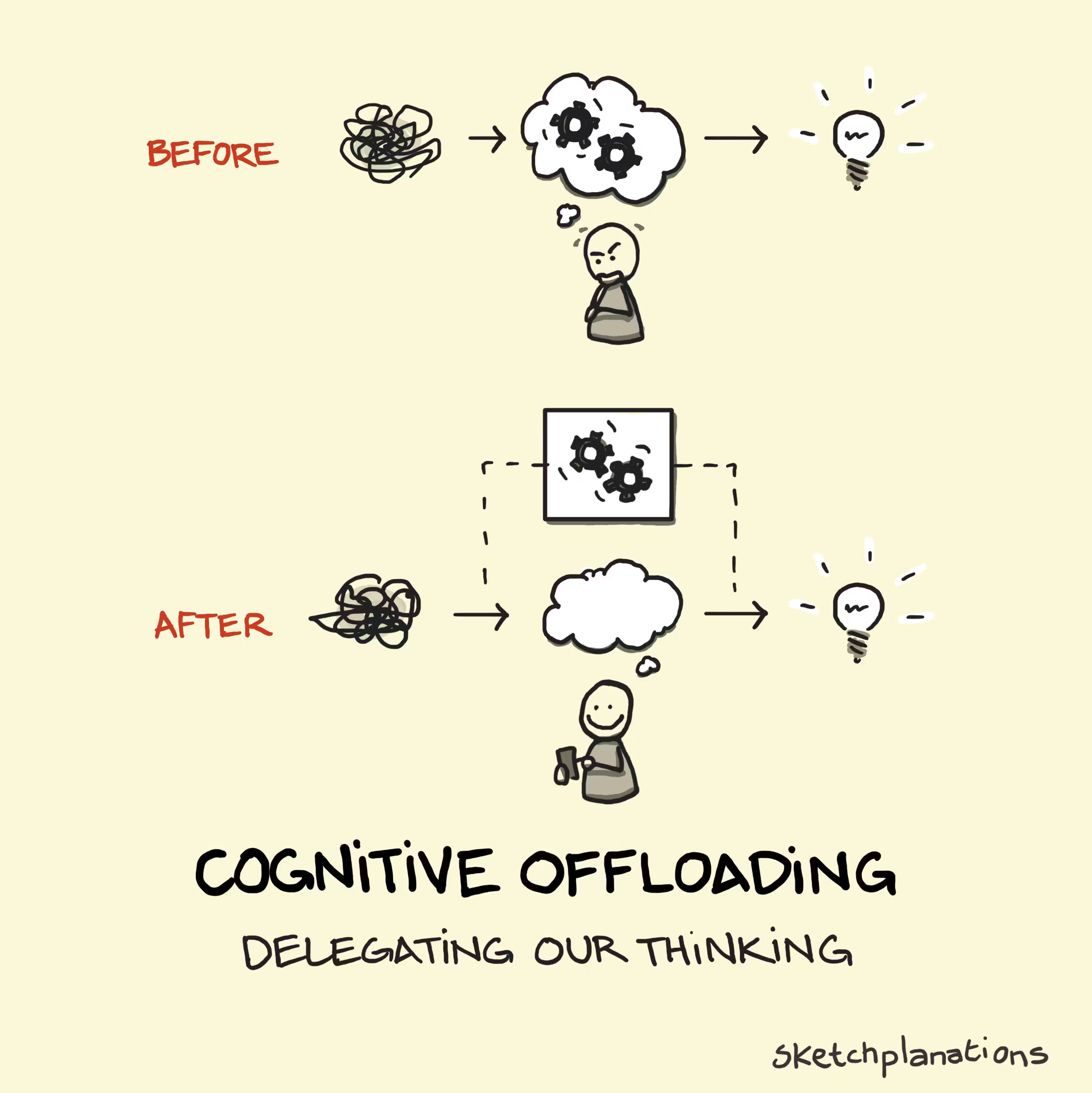
Lastly, the article on “cognitive surrender” takes cognitive offloading to the next level. Not only are we reducing our capacity to comprehend new information when we use AI, but those researchers at the University of Pennsylvania found that we also tend to give in to AI responses without critically analyzing them. Due to AI’s sycophantic responses, people are much more likely to believe an AI chatbot and “surrender” their skepticism to it. This is deeply concerning when we consider how easily persuaded the teenage brain is.
How Skills-Based Health Ed Can Help
If we truly believe in the power of skills-based health education, then we need to push back against the proliferation of AI use in our schools. Teaching students how to think critically and analyze, is teaching them how to be cognitively healthy. Practicing these thinking skills should be a foundational part of any Health class. Project Zero Thinking Routines are the best place to start. Here are a couple skills you could try:
Health Skill: Analyzing Influences
Thinking Skill: Analyzing
Before we put scenarios in front of students, we should be teaching them how to analyze:
- See, think, wonder – Introduce your students to the influence and have them get a foundational understanding of the situation while generating curiosity. In order to analyze the influence, there should be some general inquiry at the start.
- Chalk Talk – Have students generate questions to analyze an influence. Which questions elicit meaningful answers? Which questions help the person gain perspective? Make a class list of all the questions
- Layers – How is this influence presenting themselves? Have students break down the most apparent and more subtle information the influence is displaying. Through inquiry, have students use this information to better understand and organize the influences in their lives
Health Skill: Accessing Valid and Reliable Information
Thinking Skills: Evaluation, Skepticism, and Metacognition
The internet, social media, podcasts, and AI have added such complexity to research that it can feel impossible to find an answer to anything. One “expert” can be pitted against another, with seemingly equal credentials, and both be holding research to support two completely different perspectives. Even as adults we struggle to handle these situations and this struggle will only continue if we surrender ourselves to AI outputs. We need to teach students how to evaluate a source (CRAAP Test), how to practice skepticism, and how to use metacognition when researching. Some ideas:
- Claim, Support, Question: Share a popular health claim and explain your thought process as you model the three steps. Then have students choose their own claim, find evidence, then (most importantly) develop questions around what information is still missing. Push students to ask deeper questions. As Project Zero states, “Thoughtful questions that challenge the plausibility of a claim often lead to a deeper understanding of the topic and the reasoning process”
- Stories: Have students research a claim of their choosing. Have students ask themselves which stories could be told about the claim: What is the history behind this? What is the bigger picture story this fits into? What are some smaller stories that are overlooked by this source? In our health class, we had students practice this with old wives tales. Why might someone have come up with this tale? Are there smaller stories where it may actually be true?
- Facts or Fiction: Have students select the author of a source or a claim in their research and run it through the suggested questioning:
- What do you think is being conveyed by this?
- Who would decide to convey this message? Why?
- How else could this be interpreted?
- What do you believe is true in this? What makes you think that?
The more we teach students to be skeptical, the more likely they are to make informed decisions. There is value in providing time for research. Students need to understand that almost all research worth something cannot be answered in a split second AI response.
Conclusion
These are just a couple examples of how we can teach students thinking skills in health class. Every health skill can be broken down into thinking skills. I believe that practicing them is the most important way we can support our students in the age of AI.
And if this doesn’t convince you to keep AI out of our schools, here are some other reasons:
- Kohn’s Zone Podcast: “A.I., as in Anti-Intellectual” on Spotify, Apple, Etc.
- Environmental Impact
- A.I. Bias
- Teens and Chatbots – “AI chatbots exploit teenagers’ emotional needs, often leading to inappropriate and harmful interactions”
- This all started after I read a story (NPR) about a teen committing suicide after using ChatGPT. I was devastated and I needed to understand how that could happen. Although ChatGPT vowed to “redesign their chatbots to make them safer”, we cannot just assume this will never happen again; especially as AI companies actively fight to prevent regulation of their products.
If you enjoyed this blog post, you might also enjoy:
Intention Is Everything by Matt Hagedorn
Appetite and Curiosity by Kurt Weiler
5 Ways That Cell Phone Use Negatively Impacts Athletes by Andy Milne
Access 150+ bite-sized microblog posts from guest educators here

