
This post uses the recommended ‘Best Practices’ from the Educate US “So You Want to Speak Up For Sex Education”
Claim your power:
Before becoming a licensed Health Educator, I worked for Planned Parenthood for five years. My work as a ‘Clinic Assistant’ in the health center included delivering ‘pregnancy tests and options counseling’ visits, as well as being in the exam room to support the patient and/or provider during in-clinic abortion visits. The process for getting trained to do ‘pregnancy test and options counseling’ visits was extensive and specifically aimed at learning how to deliver medically-accurate, judgment-free information about pregnancy options, including medication and in-clinic abortions.
Share values, stories and emotions:
I delivered hundreds of ‘pregnancy test and options counseling’ visits, where my role was to hold space for the individual, while providing nonjudgmental information and resources meant to support them in making their personal decision. For a positive pregnancy test visit, I would share the result, give the patient a moment to process, and ask if they had any questions. It was never about leading the individual towards a choice. The choice is fully up to the pregnant person, who’s body is carrying the pregnancy. For examples of what this might sound like, check out these two videos about abortion:
Because of my experience doing that work, I believe fully that it is not only possible but necessary to deliver medically-accurate, fact-based information about abortion access, including acknowledging the strategic attempts to restrict access to abortion care. It is possible to create a space where we can talk compassionately about what it means to consider our own values and beliefs and make autonomous decisions about our own bodies.
Don’t repeat a lie even to refute it:
By using the National Sex Education Standards to teach about Abortion, we keep learning centered on two, skill-based standards: accessing valid information and analyzing influences.
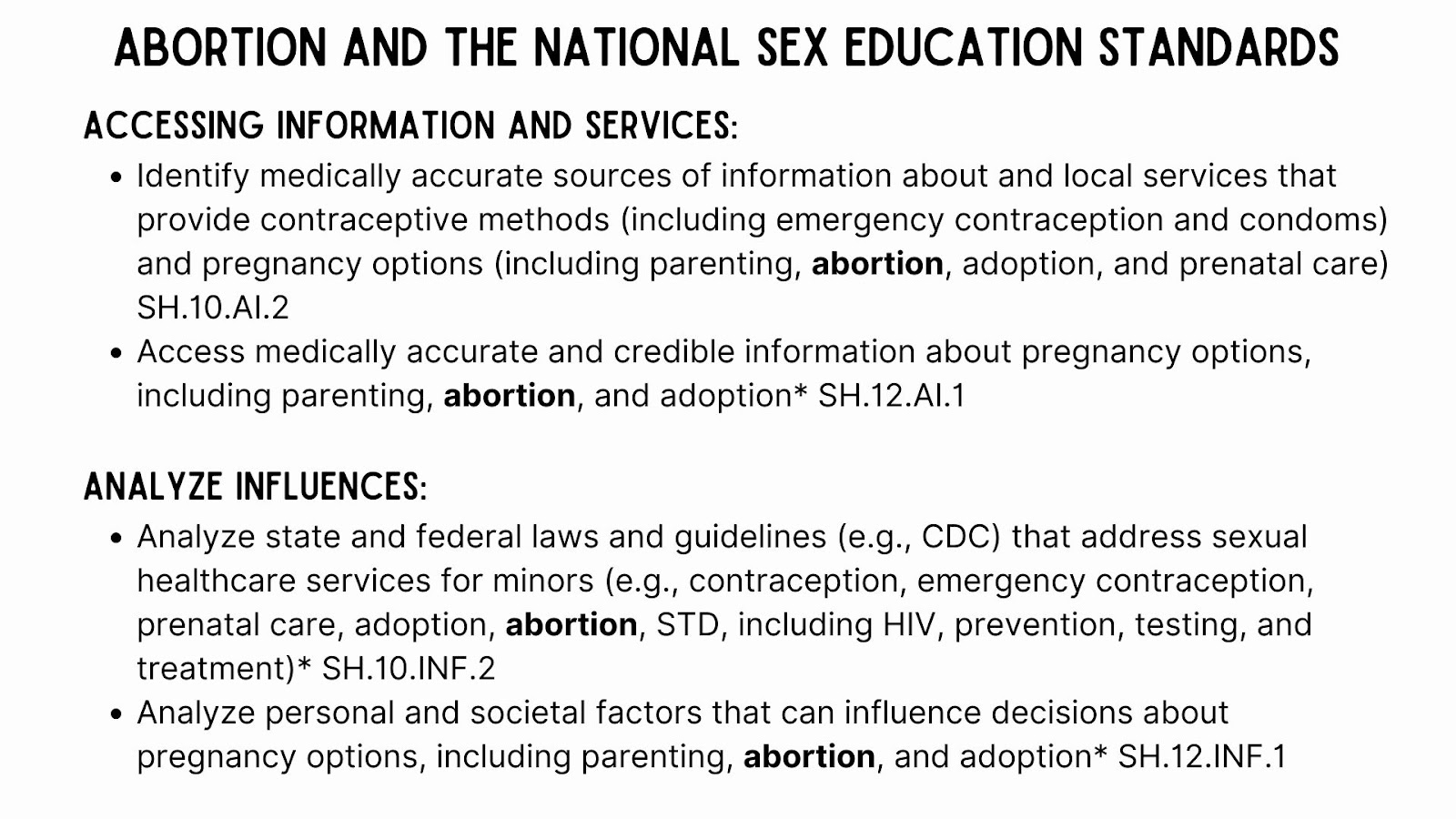
The above standards are the only that include abortion. This is yet another reason to not debate the topic of abortion in the Health Education classroom. The standards tell us to focus on medically accurate information, the laws surrounding abortion access, as well as the societal or personal factors that influence someone’s ability to make an informed decision about their pregnancy.
We can acknowledge that people have varying beliefs and values when it comes to abortion and reproductive health. However, focusing on the standards ensures that students learn valid and medically-accurate information, as well as consider the complex influences that impact people when they are making personal choices about their bodies and futures.
Check out this Canva slideshow for an example of what an Abortion Access lesson can look like.
Big shout out to the folks whose work inspired this lesson:
Repeat yourself:
Abortion is health care. It is about having bodily autonomy to make decisions about your own health and future. Teaching about abortion access means that we reinforce that abortion is a safe medical procedure, when legal and accessible. We acknowledge that there have been strategic attempts to restrict access to abortion, within the United States and throughout the world. And we can focus on providing nonjudgmental, medically-accurate, and fact-based information that allows people to make informed decisions about their own health.
Learn more about teaching comprehensive, nonjudgmental, medically-accurate sex education:
- National Teacher Preparation Standards for Sexuality Education
- Rights, Respect, Responsibility A K-12 Sexuality Education Curriculum – Teacher’s Guide
- Educate US – SIECUS in Action – take the sex ed voter pledge
Learn more about supporting abortion access in your community:
This microblog post was a featured post in #slowchathealth’s #microblogmonth event. You can search for all of the featured posts here. Please do follow each of the outstanding contributors on social media (including Emily Zien, the author of this post) and consider writing a microblog post of your own to be shared with the global audience of slowchathealth.com
Pair this blog post with the following:
Dear Health Educators, Please Do Not Debate Abortion in Your Classroom by Emily Zien
Addressing the Future of Abortion With Students by Ellen Friedrichs
What Divides Us, Becomes Us by Michelle Rawcliffe
It’s Time To Speak Out by Drew Miller
Have you read the latest Book of the Month recommendation?
 #slowchathealth