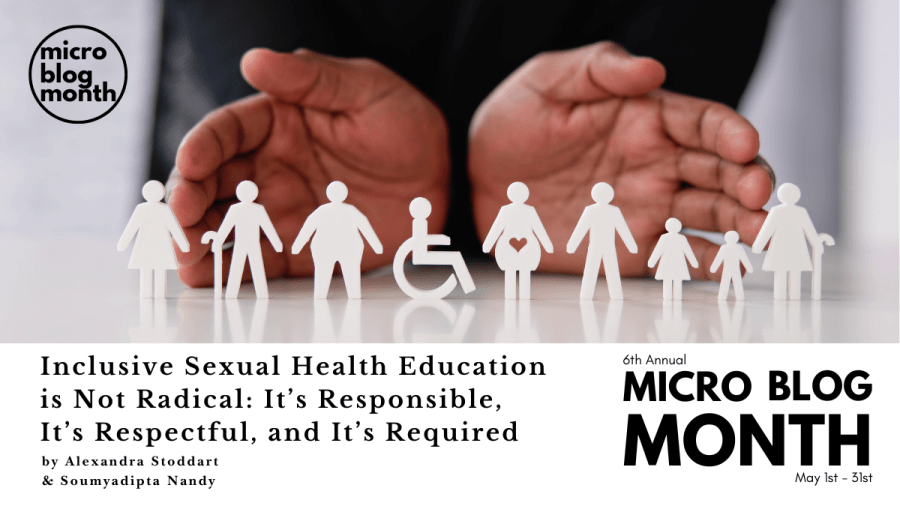
Preface: Although we write this blog from a Canadian perspective, we know that this topic is relevant within the American landscape as well. We recognize the complexities that currently exist advocating for and implementing inclusive sexual health education.
Teacher Educator Perspective (Alexandra Stoddart)
While it has many names, sexual health education (also known as sexuality education, sex ed, sexual and reproductive health education, comprehensive sexual health education) is critical for teachers to teach and students to learn. Comprehensive sexual health education (CSHE) covers a vast array of important information, e.g., bodily autonomy and consent, sexual and gender-based violence/harassment/coercion, interpersonal relationships, bodies and development, reproductive health, and more. In today’s world with so much disinformation and misinformation, students need to be getting evidence-based information so that they can make safe and independent decisions. Although sexual health education tends to be part of the curriculum where parents remove/opt out their children from learning, the majority of Canadian parents see value in it (Wood et al., 2021). Historically, sexual health education has focused on the white, cisgender, able-bodied, neurotypical, and heterosexual experience. This lens excludes the lived experiences of many of our students. We have witnessed and continue to witness colonial and systemic injustices in multiple sectors such as our healthcare system (see Boyer, 2017). Students need to be supported with evidence-based information so that they can advocate not only for themselves but for others now and in the future. Research has shown that CSHE is beneficial for numerous reasons including:
Delayed initiation of sexual intercourse; reduced sexual risk-taking; increased condom use; increased contraception use; increased knowledge about sexuality, safer-sex behaviours, and risks of pregnancy, HIV and other STIs, improved attitudes related to sexual and reproductive health (e.g. positive attitudes towards things like using condoms, seeking and getting sexual health care, nurturing healthy relationships, seeking consent, etc.)
(Action Canada, 2020, p. 6)
Teaching and learning about all forms of health education [HE] that are anti-racist, anti-ableist, anti-sexist, and overall anti-oppressive are integral for students who will need this information to keep them safe and make their own autonomous decisions about their health and well-being. Recently research has indicated that “many [Canadian] teachers felt under-prepared to effectively teach” the subject of health education and that this was even more pronounced for sexual health education (Sulz et al., 2024, p. 56). Maine et al. (2024) found that 100% of the trans and non-binary youths in their study indicated that their school sexual health education did not adequately meet their needs. “Ensuring that teachers are adequately equipped and confident in their ability to teach HE not only empowers them, but also holds the potential to better align their teaching with the educational needs of students within HE classrooms” (Sulz et al., 2024, p. 58). In order for K-12 students to learn about CSHE, it is imperative that pre-service teachers/undergraduate students are learning about it and reaching a place where they feel comfortable teaching it. Shifting from the teacher educator perspective, the following section eloquently articulates how essential this content is from the perspective of an undergraduate student.
Undergraduate Student Perspective (Soumyadipta Nandy)
Growing up, for many students, sex ed felt like reading a book with half the pages torn out. Sex ed is supposed to be a guiding tool – a map to help us navigate ourselves, relationships, identities, and boundaries. However, that map was often incomplete, drawn in lines that did not make up a clear path. Students were given fragments of information, taught in hushed tones and rigid binaries, and somehow still expected to build full understandings of themselves from pieces that may have never truly fit.
In classroom settings, where sex ed is meant to be inclusive, many students were never invited into the conversation. When they were, it was through a lens that did not see them thoroughly—not if they were of colour, not if they were part of the 2SLGBTQ+ community, and not if they had any form of disability. In other words, not if they dared to exist outside the confined box of “normal”.
As a student, I understand how powerful education can be and, even more so, how devastating its absence is. Inclusive sexual education is not just important, but essential. To be truly effective, it must be race inclusive, 2SLGBTQ+ inclusive, and attentive to the lived experiences of individuals with disabilities. Anything less reinforces silence, shame, and systems of exclusion. More often than not, traditional sex ed centers around white, cisgender, heterosexual, able-bodied experiences as the default – as if all other ways of existing are deviations. Our classrooms—like our communities—are not homogenous. This is why our education system must realize this diversity and implement sex ed that speaks to every student.
There needs to be an immediate call for action on these matters, as we urgently need more resources within the classroom that reflect the realities faced by marginalized students. This is especially since insufficient sex ed can result in the jeopardization of students’ autonomy and safety. Further, there needs to be inclusive sex ed that acknowledges 2SLGBTQ+ identities – not as footnotes in a story, but as central characters. When sex ed neglects to recognize race, it undermines the realities of systemic racism, generational trauma, and cultural contexts that shape how individuals understand sexuality and care. When it fails to affirm queer and trans students, it tells them – explicitly or implicitly – that their identities are nonexistent. When it excludes people with disabilities, it denies their autonomy and erases their right to sexual agency.
In many ways, inclusive sex ed is a form of justice. It acknowledges that every student has the right to see themselves reflected in what they learn in the classroom. It provides a safe space to ask questions, set boundaries, communicate needs, and understand that pleasure and safety can be intertwined. Moreover, it affirms that all bodies are worthy of respect, all identities are worthy of recognition, and all relationships are worthy of dignity.
As a voice of students, I want inclusive sexual education that prepares us all not just to avoid risk, but to pursue meaningful connection. I want sexual education that doesn’t whisper but speaks clearly and proudly about the realities of our diverse lives. Lastly, I want an education that equips us with knowledge not rooted in fear, but in care. This issue is beyond just curriculum adjustments; it’s about shifting culture. Inclusive sex ed fosters empathy, reduces stigma, and builds a society where individual differences are not feared, but embraced. It teaches us how to live and love, informed and with integrity.
We cannot afford to keep leaving people out. We cannot keep telling students – through omission – that they do not matter. Inclusive sex education is not a radical idea, it is the bare minimum. I believe education should be a place where everyone is seen and inclusive sex ed is how we make that promise a reality.
References & Resources
Action Canada. (2020). The state of sex-ed in Canada. Action Canada for Sexual Health and Rights. https://www.actioncanadashr.org/sites/default/files/201909/Action%20Canada_StateofS exEd_F%20-%20web%20version%20EN.pdf
Boyer, Y. (2017). Healing racism in Canada. CMAJ, 189(46), E1408-E1409, 10.1503/cmaj.171234
Maine, E., Hardy, T., & Wells, K. (2024). “This is killing me. Please let me leave”: Trans and non-binary youth and sexual health education in Alberta. The Canadian Journal of Human Sexuality, 33(3), 315-328. 10.3138/cjhs-2024-0042
Milne, A. (2021). In support of Comprehensive Sexuality Education. https://slowchathealth.com/2021/05/17/in-support-of-cse/
– Andy previously discussed Comprehensive Sexuality Education [CSE] in a microblog that shared resources and benefits of CSE.
SIECCAN-Sex Information and Education Council of Canada. (n.d.). SIECCAN-Sex Information and Education Council of Canada. https://www.sieccan.org/
– For those who are looking for resources and support in how to teach evidence-based inclusive comprehensive SHE, Sex Information and Education Council of Canada (SIECCAN) is a great place to start.
Sulz, L., Robinson, D. B., Morrison, H., Read, J., Johnson, A., Johnston, L., & Frail, K. (2024). A scoping review of K–12 health education in Canada: understanding school stakeholders’ perceptions. Curriculum Studies in Health and Physical Education, 16(1), 41–63. https://doi.org/10.1080/25742981.2024.2311113
Wood, J., McKay, A., Wentland, J., & Byers, S. E. (2021). Attitudes towards sexual health education in schools: A national survey of parents in Canada. The Canadian Journal of Human Sexuality, 30(1), 39–55. https://doi.org/10.3138/cjhs.2020-0049
This microblog post was a featured post in #slowchathealth’s #microblogmonth event. You can search for all of the featured posts here. Please do follow each of the outstanding contributors on social media and consider writing a microblog post of your own to be shared with the global audience of slowchathealth.com
Pair this blog post with the following:
What Sean Mendes Can Teach Us About Sexuality by Drew Miller
In Support of Comprehensive Sexuality Education by Andy Milne
Considering Gender Combined Sex Education by Betty Barsley-Marra
Sex Ed Needs You by Christopher Pepper
What Divides Us, Becomes Us by Michelle Rawcliffe
Have you read the latest Book of the Month recommendation?
 #slowchathealth
Pingback: What Shawn Mendes Can Teach Us About Sexuality – #slowchathealth