I once wrote a blog post about the value of revisiting saved social media posts and screenshots because sometimes “the best inspiration is already in your pocket—literally.” Like many teachers, I’m a collector of great ideas. I hit save on Instagram posts that inspire me. I pin classroom strategies and eye-catching infographics to Pinterest boards I haven’t visited in months. I bookmark tweets that I know might be useful in the future, I flip my favorite sleep articles to Flipboard, and I have a camera roll full of screenshots from all manner of sources. It was one such screenshot, a message from Australian educator Andy Hair, that encouraged me to take a deep dive into the Filipino tag game Patintero in order to introduce it to my junior and senior Lifetime Activities class.
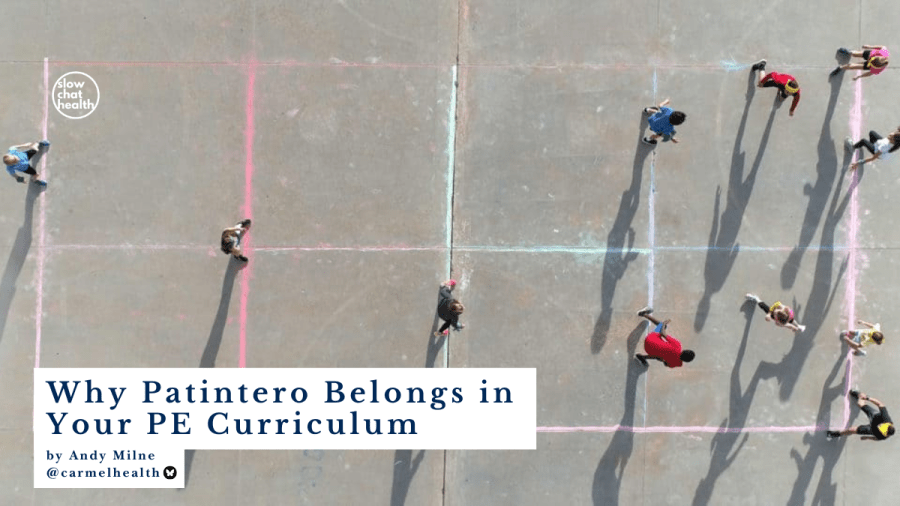
Patintero is a traditional street game from the Philippines, played for generations by children in neighborhoods, schoolyards, and side streets, often in the early evening under streetlights. No equipment. No fancy setup. Just chalk lines and a group of kids ready to compete. I’ve even seen a video where the lines are ‘drawn’ on a dusty street using water carefully poured from a bottle. The game really is that basic…and yet, the strategy needed to play the game is more complex that one would imagine.
Decolonizing the PE Curriculum
Introducing this game aligns with another aim of mine, again the subject of another blog post, that of decolonizing the physical education curriculum. In that blog post I asked “Why is it that my PE curriculum is dominated by North American and European team games and activities? What is it that I am hoping to teach my students when I ask them to participate in PE and can I achieve those same outcomes, or more, through a new sport or activity from another part of the world?“
Decolonizing physical education means expanding beyond a narrow set of Western, sport-dominant traditions and recognizing that movement cultures exist all over the world. By introducing games like Patintero, we acknowledge that valuable physical practices come from Southeast Asia just as much as they do from Europe or North America. This shift broadens students’ understanding of global cultures and challenges the idea that only certain sports or traditions are worthy of study in schools.
When we introduce students to games from other cultures, we’re doing more than diversifying activities. We’re broadening perspectives. We’re saying movement isn’t owned by one country, one sport system, or one tradition. It’s global. It’s creative. It’s communal.
Patintero features communication, team strategy, risk-taking, spatial awareness, and a whole lot of joy. And it does this without any equipment.
How the Game Works
The court is a rectangular grid, typically arranged 2 squares wide by 3 squares long. Each square can be about 2–3 meters per side depending on age and space.
Teams
- One team are the runners.
- One team are the taggers.
Taggers – Taya in Tagalog, meaning tagger.
- 4 players stand on the horizontal lines.
- 1 player stands on the center vertical line.
- Taggers must keep at least one foot on their assigned line at all times.
- They may only move along their line to tag runners.
Runners – Tumatakbo in Tagalog, meaning “one who is running”.
- 6 runners begin behind the starting baseline.
- On the signal, they attempt to move through the grid to the far end.
- If they reach the far baseline safely, they earn a point.
- If they return safely to the starting side, they earn additional points (depending on scoring format).
- If tagged, they are out for that round.
Rounds typically last about two minutes before teams switch roles.
Patintero is fast. It’s tactical. It rewards teamwork over dominance. And perhaps most importantly, students love it. It was noticeable how swiftly the strategic element of the game developed. Initial attempts at playing the game looked like 6 individuals trying to cross the grid without getting tagged. Realizing that this method meant that the team were all tagged quickly, students came together and sent teams of runners in an attempt the split the taggers. In turn, the taggers realized that with better communication, they could trap runners, making it impossible for them to achieve their goal.
Patintero and Meaningful PE
Patintero naturally aligns with Meaningful PE because it elevates social interaction, challenge, and joy all at once. Success depends on communication, anticipation, and collective strategy rather than individual dominance. Runners must decide when to take risks; taggers must coordinate and read movement patterns. The result is a game where students feel competent, connected, and emotionally invested. I noticed that it wasn’t always my most athletic students having the most success. When students encounter a game they’ve never played before, everyone starts at the same place. Prior experience matters less. Status hierarchies flatten. It was one of my more disengaged students who exclaimed “Wait, don’t we get one more game?” when I decided that it was time to finish the lesson. Introducing unfamiliar activities like Patintero keeps curriculum fresh and signals that PE is a space for exploration.
Thoughts From My Students
Following on from the success of my volleyball lesson and asking students reflection questions and recording their responses, I did the same at the end of our Patintero lesson.
Question 1: Describe this game in 3 words.
I heard Unique. Strategic. Competitive. Fun. Fast. Teamwork. Quick.
Question 2: What made this game fun (or frustrating?).
Fun: It’s different, we haven’t played anything like this before. You have to use problem solving skills, and strategy skills. I like how it’s fun when you are the runner and also fun when you are the tagger. It’s big on teamwork.
Frustrating: You can get frustrated when you’re trapped by the taggers. It’s hard when the other team strategizes against you.
Question 3: How is this game different (or similar) from American playground games?
It’s a little similar to Pac Man, but I can’t think of any other game that it’s similar to. It’s more engaging than the tag we played when we were younger. Patintero requires more focus. Yeah, you’re focused the whole time. I like the short rounds, and the points make it clearer who is the winner. There’s more brain power involved and less dominated by athletic ability.
On the topic of novelty, in his undergraduate dissertation at Loughborough University, Daniel Sanders (2025) discussed the role of Alternate Activities (AA’s) as a pathway to Meaningful PE. Sanders stated “there is a growing argument to ensure [AA’s] feature more often in PE, potentially promoting increased engagement”. It was the view of teachers involved in the study that the use of novel sports (and by extension activities such as Patintero) could be used “to create more meaningful experiences and align naturally with MPE features” (1)
Question 4: Why should PE include games that don’t originate from America or Europe?
Students struggled a little with this question. I prompted them by sharing that I can bring cricket and Rugby from my culture, but also that I will introduce them to Tapuwae, from New Zealand, in a few weeks time.
We can see how other kids have grown up. Helps us understand different cultures, and be more empathetic.
Note: One student pulled out her phone, and texted her Fillipino mom to ask her if she ever played Patintero as a kid. Her mom texted back to confirm that not only did she play the game as a child, but that she was actually very good at it too! I think that moment in itself highlights the connections that can be made when we make our curriculum more diverse.
Question 5: Would you modify any rules to make the game better?
I acknowledge that it might not be a great look – a British teacher encouraging his American students to find ways to improve a game from another culture but…..my students have free license to modify all games to make them suit their needs. Our modifications typically make our games more inclusive – allowing second serves, multiple bounces etc.
Initially we played Patintero with two meter squares, but they were too small. It was far too easily for taller taggers to reach the runners. In today’s lesson we increased the squares to three meters, but some students wondered if we could make the squares even bigger next time.
Some students felt that the middle tagger, the one who moved along the center line, wasn’t as engaged as the rest of the taggers, and maybe could be removed. That said, in one game, the central tagger coordinated with two horizontal taggers and effectively shut down the game by trapping 3 runners.
We played with a rule that awarded one point for passing through the taggers, and a second point if you returned. Runners were given the option to stop after the first point. They could bank the point, but if they took the risk of trying to return through the taggers and were caught, they lost all of their points. In hindsight this wasn’t a great rule and students wondered if the point could be ‘cashed in’ to free a tagged player.
Students also didn’t like the elimination aspect of the game and pondered the introduction of a ‘jailbreak’ option.
Question 6: If you were explaining Patintero to someone who had never played it, what would you say makes it worth playing?
It’s fun and energetic, but you also have to think and use strategy. It’s a great team game, encouraging team bonding. It’s energizing.
I wanted to write this blog post for a number of reasons. Obviously I love to feature my students voices, and I enjoy sharing new games with PE teachers. I also struggled to find many resources that explained the game in a way that I completely understood. I’ll share some of the videos I checked out, and also acknowledge that Chat GPT helped answer my many questions to get to a level where I felt comfortable introducing a novel tag game to my students. If I have misrepresented any elements of the game I welcome feedback.
(1) Sanders, D. (2025). Broadening the scope for physical education (PE): Exploring alternative activities (AAs) for enhancing meaningfulness in PE for diverse student needs (Undergraduate dissertation, Loughborough University).
Pair this blog post with the following:
 #slowchathealth