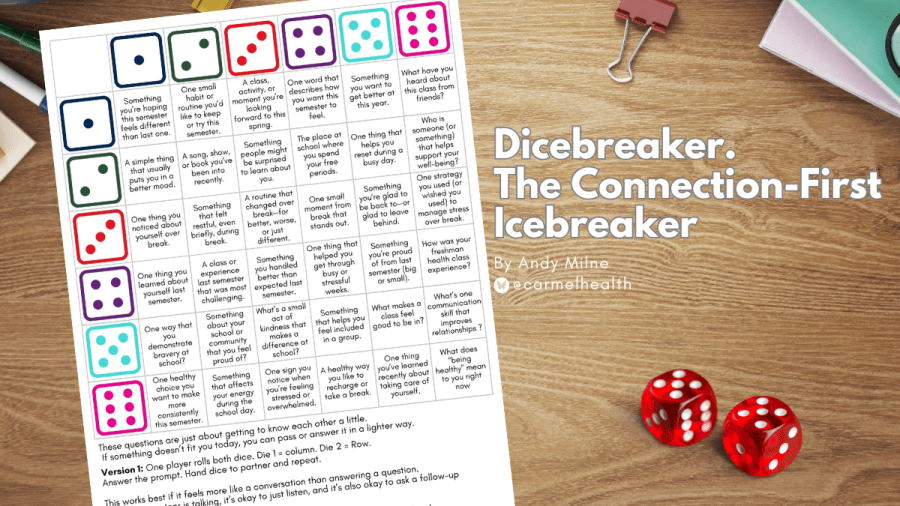
Ever since I watched Dale Sidebottom keynote at the PE Institute in North Carolina I’ve wanted to weave in some dice-based activities with my classes. I found this great deal online for 100 dice, but they sat in a drawer unaccompanied by an activity, until now.
We return from break on a shortened schedule, and I meet my new second-semester students for just 20 minutes on day one. This simple activity creates an easy, low-pressure way for them to (re)acquaint themselves with classmates.
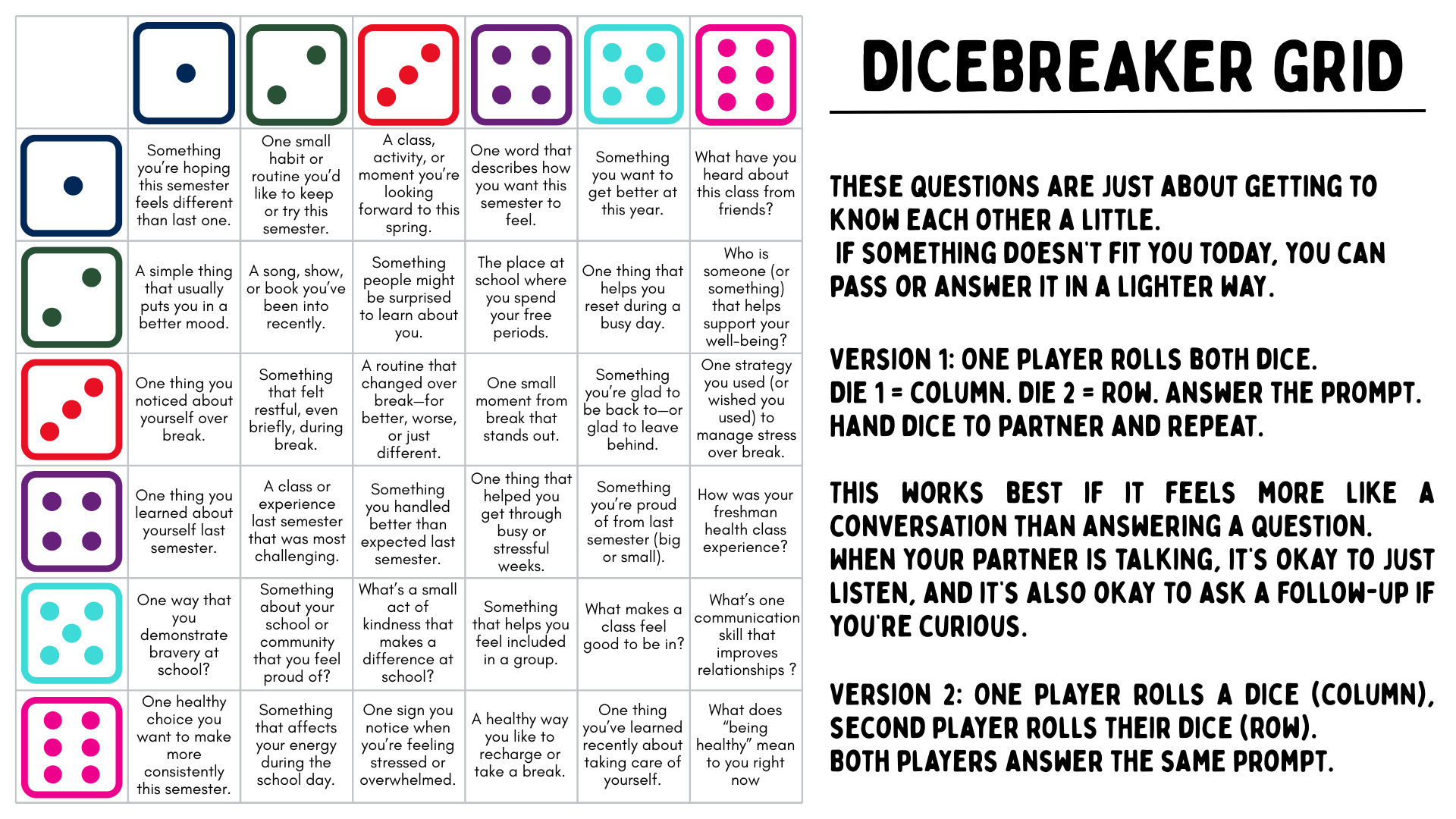
On the surface, it’s simple. Two dice are rolled, a square on a 6×6 grid is selected, and the prompt in that square becomes the conversation starter. Each prompt is written to guide conversation without forcing depth or personal disclosure.
Students work in pairs and take turns rolling and responding. They’re told from the start that they can pass or answer in a lighter way if a question doesn’t fit them that day. That permission matters. It lowers anxiety and allows students to engage honestly, at their own comfort level. Every prompt can be answered simply or explored more deeply, and students get to decide which direction the conversation goes.
The structure of the grid also does some quiet work in the background. Prompts connected to a roll involving the number one are forward-looking, helping students think about the second half of the year and the new semester ahead. Prompts involving a six are loosely related to health skills. Reflection on winter break is framed around noticing rather than judging, with sensitivity to the fact that not every student may have had a positive experience away from school.
One row of the grid is intentionally aligned with our school initiative that encourages bravery, pride, and kindness. The emphasis throughout is on listening, curiosity, and connection. I remind students that it’s okay to ask follow-up questions and that they’re not there to evaluate each other, just strengthen connections with each other.
The Dicebreaker Grid isn’t loud or complicated. It doesn’t demand vulnerability or performative sharing. It simply creates space. In a short amount of time, students talk, listen, laugh a little, and begin to feel more connected to the people around them. For me, that’s exactly how a new semester should begin.
Download the Dicebreaker slide.
Download the 8×11.5″ printable Dicebreaker sheet.
Similar, but very different, here is another grid-based activity that builds class community without the need for dice!
*I have a screenshot of a version of a dicebreaker activity on my phone. I don’t know where I saw it. If this was you, please let me know so that I can give you a shout out.
If you enjoyed this blog post, you might also enjoy:
Using Dice in the Health Classroom by Jessica Matheson

 #slowchathealth