Every semester, after introducing the content of my sexuality education unit, I conduct an anonymous question activity with my sophomore health class. I ask them to ask questions they have about any of the content, but I also take this a step further. I ask them to suggest content that they think their peers definitely need to hear. Perhaps they are advocates for greater consent awareness and have a resource to share, or a message that simply must be included.
This activity is simple, but it gives me a window into what my students actually need from me, beyond the curriculum guide, beyond the slides, beyond what any textbook says is “important.” It’s a space where they can ask the things they’re curious or confused about, and it’s always humbling to see how honest and thoughtful their questions and comments can be.
A few years ago, a group of girls submitted notes that encouraged me to expand my teaching content. They wanted me to include more information about menstruation, and not just the biology of it. They wanted boys to understand the changes girls go through during their periods, to be aware of mood changes, and to know how to support their peers. I took their feedback seriously and reshaped my lessons. Since then, the material has been received positively by all genders. And, honestly, it’s been one of those “why I teach” moments – proof that student voices can drive meaningful change in the classroom.

This week, following my menstruation conversations, I experienced student interactions that reminded me that the work I do is so invaluable.
In my Period 1 class, a boy casually mentioned that he carries a tampon in his backpack, just in case his girlfriend, or anyone he cares about, ever needs one. There was no fanfare, no joke, no awkwardness. Just quiet, considerate kindness.
The following day, during Period 5, after our menstruation lesson, another boy asked a question that warmed my heart:
“What more can boys do to support girls when they’re on their period?”
The reaction was instant. A murmur of approval rippled through the room, followed by clapping from the students – boys and girls alike. And then, as I began to answer, I realized something: they didn’t need my voice, they needed each other’s. So I opened the floor. Hands shot up, including from girls who rarely speak. They shared their personal experiences, their preferences, and what genuine support actually looks like. I sat back, a little awestruck, and let them talk. They shared their experiences honestly, courageously, and sometimes with a hint of humor.
Moments like this remind me why inclusive, non-gendered teaching matters. If these lessons had been the traditional, gendered type – boys in the gym, girls in the classroom – this conversation would never have happened. If I hadn’t worked to create a safe, affirming, student-centered environment over the past few months, these students wouldn’t have felt confident enough to speak.
And yet, despite the media narrative that boys are constantly under pressure to “act like men” or perform hyper-masculinity, these moments prove something hopeful: when we give young men space to be curious, compassionate, and open, they rise to it. They don’t need to impress anyone. They just do what human beings are capable of when they’re supported and trusted. The boys are going to be okay. And those who will share friendships, classrooms, and relationships with them? They’re going to be okay, too.
At the end of the lesson, I asked my students for feedback: “What was missing from my teaching?” A few students suggested I include a slide explaining the four phases of the menstrual cycle (menstrual phase, follicular phase, ovulation, and luteal phase) and the symptoms they experience during each. They wanted the lesson to be deeper, more complete, more reflective of what they actually go through. I left class that day thinking, I have work to do. I want to do better. I want all students to feel supported, seen, and understood.
Stories like this make me hopeful about the future of education and the possibilities when we truly listen to students. They remind me that empathy is teachable, that kindness is learnable, and that challenging outdated gender assumptions is happening, quietly, in classrooms across the country. And sometimes, it’s happening in small, wonderful, undeniable ways, like a boy carrying a tampon or asking a question that sparks an entire room of students to share, reflect, and support one another.
If anything, moments like this are proof that when we design lessons that are inclusive, safe, and centered on student voices, everybody wins. And that, more than anything, is why we teach.
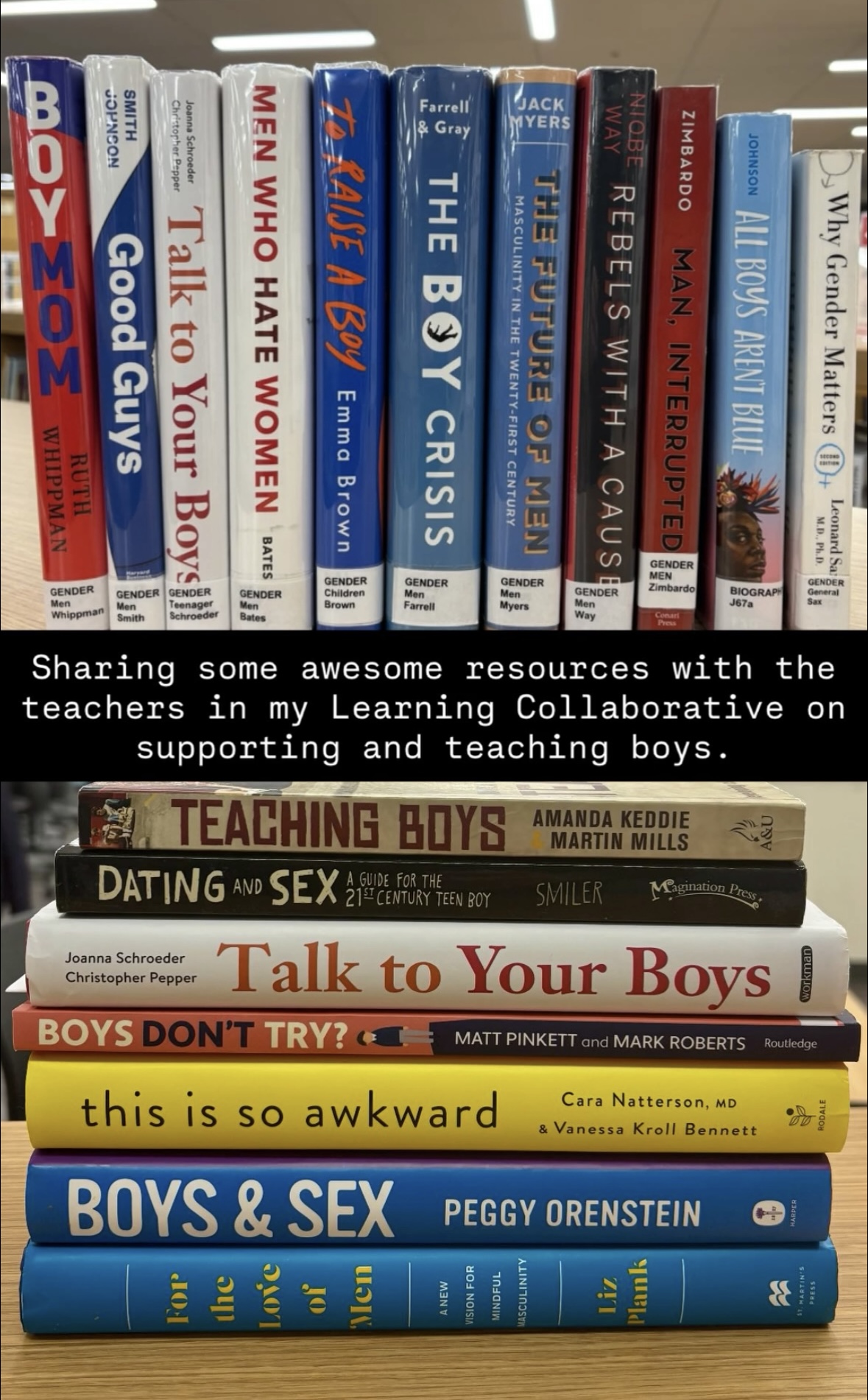
This blog post reminds me of this photograph I shared on Instagram last week. I asked my school library to pull some books for a group of teachers attending a professional development I was leading. Along with books from my own collection, here are their titles:
Boy Mom by Ruth Whippman
Good Guys by Smith & Johnson
Talk To Your Boys by Schroeder & Pepper
Men Who Hate Women by Laura Bates
To Raise A Boy by Emma Brown
The Boy Crisis by Ferrell & Grey
The Future of Men by Jack Meyers
Rebels With A Cause by Niobe Way
Man, Interrupted by Zimbardo & Coulombe
All Boys Aren’t Blue by George Johnson
Why Gender Matters by Leonard Sax
Teaching Boys by Keddie & Mills
Dating and Sex by Andrew Smiler
Boys Don’t Try by Pinkett & Roberts
This Is So Awkward by Natterson & Kroll Bennett
Boys and Sex by Peggy Orenstein
For the Love of Men by Liz Plank

 #slowchathealth
Pingback: Creating Environments for “Classroom Moments” – #slowchathealth