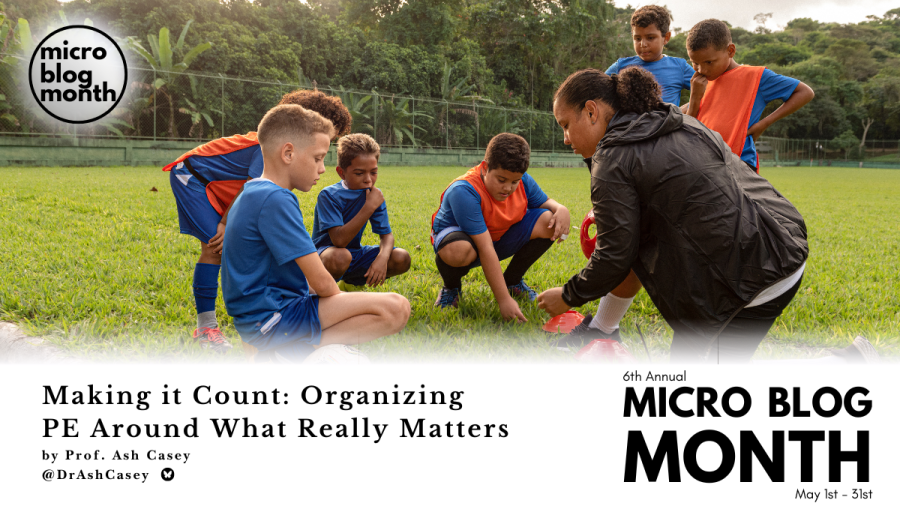
In most multi-activity curricula, when asked “what are we doing today?” the all too familiar response is “games, or aquatics, or dance and so on”. These activities are therefore “the organising centre” of your physical education programme. These are the ‘things’ we plan our lesson around them, it is the skills and techniques of these ‘things’ that we teach (often through drills), and it is these ‘things; that we then assess – often but not always in isolation. This organizing centre is a very familiar, and often central, aspect of the curricula I see and hear about in many schools, and I did the same myself as a teacher – at least in the first decade of my career.
The question I have for you through this micro blog is “why?”
Primarily, I want you to think, “Why do I/we organize our curriculum in this way?” I’m also keen to know what you think would happen if you didn’t do this?
When teachers have been asked in the past what they want kids to get from physical education the answers are rarely about learning the skills and techniques deemed necessary to play a specific sport or undertake a specific activity. No, they want kids to enjoy PE and have the capacity to life active lives. They want them to make positive decisions about being active later in life and they want them to feel competent and confident. So why not organize your curriculum to achieve those goals. If you want kids to be able to take personal responsibility or cooperate and help each other, then organise your curriculum around these things.
But what does that look like?
Imagine you want kids to take personal responsibility for themselves and you’re teaching a lesson and someone does just that. They take themselves to a different group because they want a different sort of challenge. What do you do? Do you recognise it? Do you value it? and ultimately do you reward it? Do you look to develop those behaviours?
“Well done Ash… that’s exactly what I hoped to see. It’s great to see you taking responsibility for your own development. I make sure that goes on in my class notes against your name. What do you think your next challenge is?”
Something like that perhaps?
An important thing to me is to refocus ourselves. What do you notice in your lessons? If you organise around games then, like me, you probably notice when someone performs an important skill or when someone scores. Do you notice and reward the off the ball movement that selfishly created space? Do you notice the kid who gives away the scoring opportunity so another might score? Do you stop the game and say, “great off the ball movement there Ash.” Probably not but what might happen if you did?
My advice is make conscious choices about your organising centre and makes conscious choices about how your explicitly recognise and value these things you teach. Oh, and tell the kids. Only in this way can we bring value and purpose to our lessons and our curricula.
This microblog post was a featured post in #slowchathealth’s #microblogmonth event. You can search for all of the featured posts here. Please do follow each of the outstanding contributors on social media (including Professor Ash Casey, the author of this post) and consider writing a microblog post of your own to be shared with the global audience of slowchathealth.com.
You should also check out Professor Casey’s own blog site.
Pair this post with the following:
Advocate Like A Physical Education Teacher by Lisa Paulson
How to Facilitate Deeper Connections to Physical Activity by Jordan Manley
Teaching Physical Education with Purpose: Embracing the Meaningful PE Approach by Andy Milne
Making Meaningful Physical Education Elementary Friendly by Will Westphal
Have you read the latest Book of the Month recommendation?
 #slowchathealth
Pingback: Five Questions I Asked My Middle School Students This Year – #slowchathealth