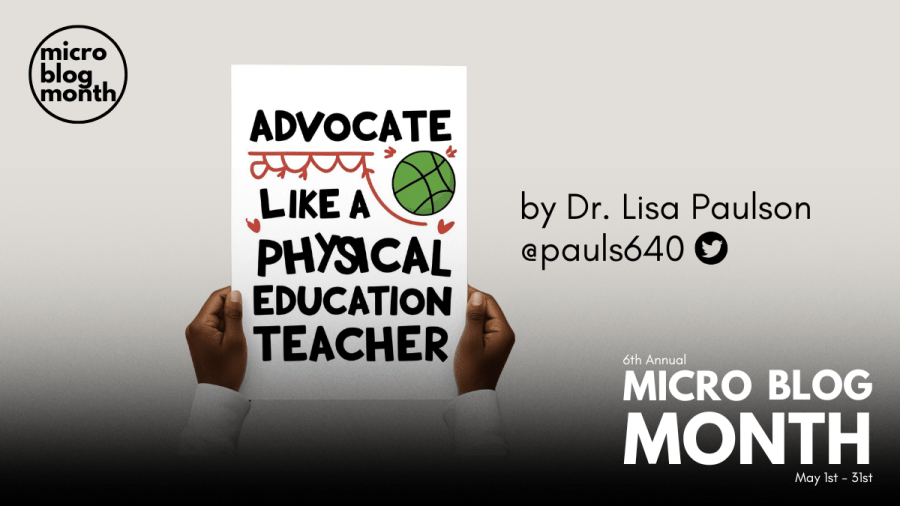
Let’s be honest: You already advocate every day, even if you don’t call it that. Holding firm on physical education minutes? Advocacy. Defending your gym space? Advocacy. Reminding folks that physical education is about the ‘E’ in ‘PE’? Every day, all day? That is advocacy!
But here’s the truth:
Now, more than ever, is the time to get off the sidelines. Our field has long faced marginalization and a lack of preparation to engage in policy; are we ‘policy illiterate’ (van der Mars et al., 2021)?
Quality physical education needs champions in your building, district, and community. That means you.
Wait… Me?
Yes, you. Whether you realize it or not, you are a policy actor—an advocate not only influencing new policy, but also shaping how current policies are implemented. Your choices and silence shape student access, equity, and well-being.
As Walton & Fisette (2020) emphasize, effective advocacy begins with critical consciousness—asking not just what a policy says, but who is making it, who benefits, and who is left out. In other words: access and equity must be central in our conversations about physical education policy.
Policy preparedness starts with three things:
1. Awareness: Understand how policy shows up in your school.
2. Know-How: Learn how to speak up, connect, and create change.
3. Motivation: Believe your voice matters. Because it does.
But how?
Let’s start by telling a persuasive story.
Researchers call it the Narrative Policy Framework (Jones & McBeth, 2010), and it’s a powerful tool for advocacy. Put simply, it shows that policy stories are more effective when they follow a familiar structure, something Morrison & Lorusso (2023) recently applied to physical education policy.
· Who are the characters? Who is involved? (e.g., a student, teacher, admin, parent)
· Identify the setting: Where is this happening? (e.g., a specific school or district)
· What is the plot? What’s the issue or change in policy?
· What is the moral of the story? Why does it matter? What’s at stake?
Here’s an (unfortunately, all too common) example:
A few students were recently excused from physical education because they were participating in the marching band. While band is time-intensive and physically active, we know that it is not a placement for quality, standards-based physical education and is unacceptable.
1. Characters:
· Heroes: Concerned physical education teacher
· Villains (or more gently, the flawed system): Well-intentioned policies that equate all physical activity as interchangeable, regardless of developmental needs
2. Victims: Students
3. Setting: High school
4. Plot: A policy allows students in marching band to waive physical education. As a result, these students miss out on key curriculum components (e.g., like fitness concepts, health-related skills, and social-emotional learning) and are not meeting national or state physical education standards.
5. Moral: Physical activity ≠ physical education. Activities like marching band may involve movement, but they don’t deliver the structured, standards-based instruction students need. The ask? Review and revise local policies to ensure only aligned, standards-based programs qualify for physical education credit.
When we tell policy stories, we must always ask: Whose voices are being centered? Whose experiences are ignored? Policy built for students must include stories from students—and those who teach and advocate with them every day.
Now that you have developed a convincing story, here are 5 tips to advocate in your school and/or district:
You don’t need a megaphone, just momentum. Start here:
1. Schedule a chat with your principal about existing physical education and physical activity polices. Think substitutions, waivers, exemptions, GPA requirements, etc.
2. Bring data about policy implementation from the United States Physical Education and Physical Activity Policy Dashboard to your next department meeting.
3. Tell a convincing story, and back it up with numbers. Decision-makers lean into evidence, but they’re also human. Stories bring the data to life. On their own, stories inspire. Data convinces. But together? That’s how you move policy.
4. Connect with your community. Testimonies from parents, nurses, students, and others can be very impactful. Build your team and invite them to the conversation.
5. ASK! Start with low-hanging fruit (ideally things that don’t cost a ton of money and that you backed up with concrete evidence and a story that pulled at some heartstrings. Then share it. Tweet it. Post it. #SHAPEAdvocacy can amplify your voice beyond your gym.
Grassroots advocacy isn’t “extra.” It’s essential. Don’t wait for “someone else.” You’re up.
The sidelines are full. We need players. Whistle’s blown. It’s Advocacy Season. Are you in?
References
Jones, M. D., & McBeth, M. K. (2010). A narrative policy framework: Clear enough to be wrong? Policy Studies Journal, 38(2), 329–353. https://doi.org/10.1111/j.1541-0072.2010.00364.x
Kern, A. L., Hanson, T., & Carson, R. L. (2023). The United States Physical Education and Physical Activity Policy (PEPAP) Dashboard: A surveillance tool to support policy implementation. Journal of Physical Activity and Health, 20(9), 566–573.
Lorusso, J., & Scanlon, K. (2023). Preparing physical educators as policy actors: Integrating the Narrative Policy Framework. Journal of Physical Education, Recreation & Dance.
Morrison, J., & Lorusso, J. (2023). Telling the story: Using narrative tools in physical education policy advocacy.
Paulson, L. (2024). Voices of Change: Exploring the Narratives of Physical Education Stakeholders’ Policy Work in Colorado (Doctoral dissertation). University of Northern Colorado.
van der Mars, H., McKenzie, T. L., & Chen, W. (2021). Policy illiteracy in physical education: A call for teacher education reform.
Walton, T., & Fisette, J. L. (2020). Teaching teachers to advocate through a social justice lens. Quest, 72(3), 263–278. https://doi.org/10.1080/00336297.2020.1753757
This microblog post was a featured post in #slowchathealth’s #microblogmonth event. You can search for all of the featured posts here. Please do follow each of the outstanding contributors on social media (including Lisa Paulson, the author of this post) and consider writing a microblog post of your own to be shared with the global audience of slowchathealth.com
Pair this post with the following:
Changing the Perception of Physical Education by Wyatt Franz
Walking Away From the Stigma by Donn Tobin
Dear Parents by Matthew Bassett
We Are Not Special by Andy Milne
Supporting Meaningful PE in Health Education by Allisha Blanchette
Have you read the latest Book of the Month recommendation?

 #slowchathealth
Pingback: Why I “Write Home”: Advocating for Health Education – #slowchathealth
Pingback: Making it Count: Organizing PE Around What Really Matters – #slowchathealth
Pingback: Is Your/Their Calling…Calling? – #slowchathealth