World Sleep Day 2026 falls on Friday, March 13, with the theme “Sleep Well, Live Better.” Organized by the World Sleep Society, this annual event raises awareness about the vital role sleep plays in our overall health and well-being.
The science is clear—quality sleep strengthens both body and mind, while poor sleep takes a toll on nearly every aspect of our health. Yet, at my school, sleep deprivation is often worn like a badge of honor. Knowing this, we dedicate two full class periods to exploring the value of sleep and why it matters.
This year, I wanted to blend my love of well-designed, downloadable calendars (often shared by organizations to spread awareness) with the important message behind World Sleep Day. So, I gave my students the following assignment.
Once we had learned about the importance of sleep and discussed ways in which students could prioritize and harness its power, groups of students were tasked with researching sleep tips that could encourage their peers to improve their sleep hygiene. I shared this sleep calendar template, created in Canva, and tasked the groups to complete it with their best sleep tips.
While many of the calendars were similar, there are only so many tips that can be shared; some of the groups went above and beyond. They decorated their template with images and added color, ultimately inspiring me to create a ‘final version’ of the calendar that was pulled from many of the group submissions.
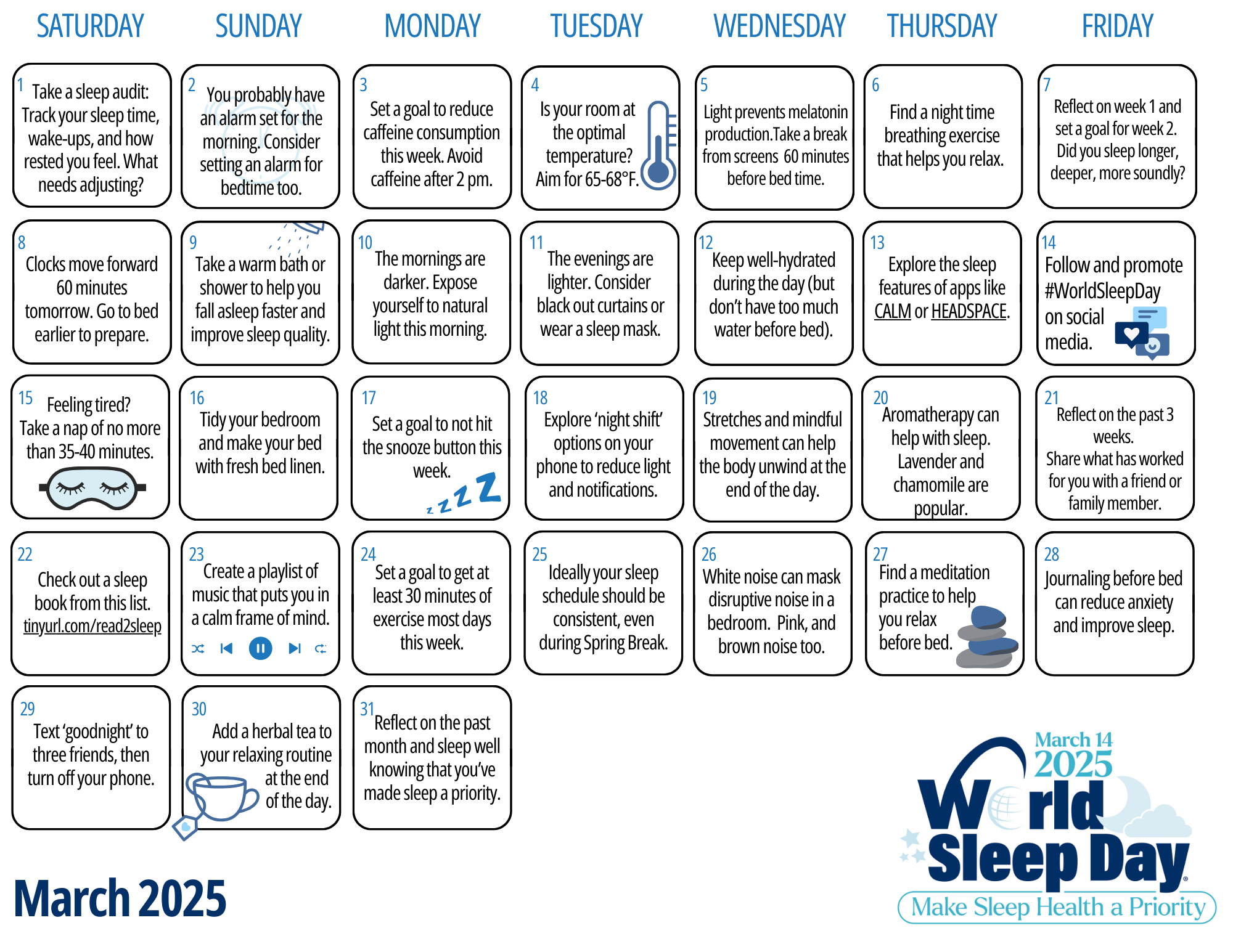
I was so impressed with the final version of the calendar that I’m sharing it widely, including with readers of this blog post. Your downloadable copy includes a link to this blog post where readers can learn more about each of the 31 sleep tips and the role they play in creating an effective sleep strategy. Additionally, at the end of this blog post you can subscribe to the 31 Days of Sleep Tips calendar to receive daily reminders to improve your sleep routine!
Obviously these student recommendations can not be taken as medical advice. If you suspect you are suffering from a sleep disorder or another health condition that is affecting your sleep, you should consult a sleep specialist.
- Take a sleep audit: Track your sleep time, wake-ups, and how rested you feel. What needs adjusting?
Conducting a sleep audit at the start of the month helps assess the duration, efficiency, and quality by tracking how much sleep you get, how often you wake up, and how refreshed you feel in the morning. This important action builds self-awareness and allows you to identify small but impactful adjustments, like setting a consistent bedtime or refining your sleep environment. This sleep calendar is packed with impactful adjustments. - You probably have an alarm set for the morning. Consider setting an alarm for bedtime too.
Just as an alarm wakes you up, a bedtime alarm helps reinforce regularity by signaling when it’s time to wind down. This behavioral change supports a consistent sleep schedule, making it easier to fall asleep and wake up feeling refreshed. Dr. Matthew Walker, the neuroscience and psychology professor at Berkeley shares the following: “Don’t set an alarm to wake up; set a clock to go to bed.” - Set a goal to reduce caffeine consumption this week. Avoid caffeine after 2 pm.
Caffeine, the world’s most widely consumed psychostimulant, can disrupt efficiency by delaying your likelihood of falling asleep and reducing deep sleep. This sleep hygiene habit helps prevent lingering caffeine effects that may lead to restless nights, promoting better sleep quality and duration. - Is your room at the optimal temperature? Aim for 65-68°F.
Not everyone has the luxury of managing their bedroom temperature, but if you can, maintaining a cool sleep environment supports quality sleep by allowing the body’s core temperature to drop naturally. Overheating can cause restlessness and night sweats, reducing efficiency. This sleep hygiene habit ensures a more comfortable and restorative sleep. - Light prevents melatonin production. Take a break from screens 60 minutes before bedtime.
Light influences our circadian rhythms, which makes light control essential before, and during sleep. Blue light from screens disrupts timing and efficiency by delaying melatonin release, making it harder to fall asleep. Gradually limit light sources before bed to help with your sleep preparation. - Find a nighttime breathing exercise that helps you relax.
Deep breathing activates the parasympathetic nervous system, reducing stress and promoting relaxation. This sleep hygiene habit improves efficiency by making it easier to transition into deep sleep. Arianna Huffington, author of The Sleep Revolution states “Counting out slow breaths (the 4-7-8 method) is one of the techniques I use. Inhale quietly through the nose for four counts, hold for seven counts, and exhale with a whooshing sound through the mouth for eight counts.” It is claimed by Dr. Andrew Weil that with practice, this method can put you to sleep in one minute. - Reflect on week 1 and set a goal for week 2. Did you sleep longer, deeper, more soundly?
As with any goal, tracking progress and setting new sleep goals encourages sleep regularity and builds awareness of the quality of your sleep. Continue with any of the tips that have worked, and experiment with the tips yet to come in the sleep calendar. - Clocks move forward 60 minutes tomorrow. Go to bed earlier to prepare.
Here in Illinois, where I currently sit typing out this blog, we are looking ahead to daylight saving time when we ‘lose’ an hour of sleep. This can disrupt timing and regularity of sleep. Adjusting bedtime in advance (preferably a few days in advance) eases the transition, preventing grogginess and improving efficiency in the coming days. To quote Dr. Matthew Walker from his book Why We Sleep, “Most people think nothing of losing an hour of sleep for a single night, believing it to be trivial and inconsequential. It is anything but.” - Take a warm bath or shower to help you fall asleep faster and improve sleep quality.
A warm bath before bed helps lower body temperature post-shower, signaling the body to prepare for sleep. Additionally, some people might feel more comfortable getting into bed feeling clean. If a shower works for you, add it to your pre-sleep routine. - The mornings are darker. Expose yourself to natural light this morning.
This tip is related to daylight savings, but harnessing natural light is a great way to train your body to prepare for, and wake from, sleep. Morning light exposure helps regulate circadian rhythms, reinforcing timing and alertness. This behavioral change promotes better wakefulness during the day and should be part of your perfect morning routine. - The evenings are lighter. Consider blackout curtains or wear a sleep mask.
Darkness is essential for melatonin production, supporting quality and efficiency of sleep. I have used this sleep mask for the past few years to ensure light exposure doesn’t interfere with my sleep. - Keep well-hydrated during the day (but don’t have too much water before bed).
According to sleepfoundation.org, “dehydration can disrupt sleep — and poor sleep can contribute to dehydration. When you go to bed without enough fluid in your body, you increase your risk of experiencing physical symptoms that make it harder to fall asleep and stay asleep, including : Dry mouth and feelings of thirst, headaches and muscle cramps. Conversely, if you sleep poorly—or if you don’t sleep long enough — you may be more vulnerable to dehydration.” Proper hydration aids bodily functions, but drinking too much close to bedtime can lead to frequent wake-ups. - Explore the sleep features of apps like CALM or HEADSPACE.
I’m a huge fan of the Calm app, and Headspace offers free access to educators. Both offer guided meditations, sleep sounds, and breathing exercises which can improve relaxation and reduce stress before bed. I use Calm’s soundscapes often to block out unwanted noise both at work and home. Calm also offer a free downloadable sleep journal. - Follow and promote #WorldSleepDay on social media.
Spreading awareness encourages a community focus on sleep health. This educational action reinforces the importance of prioritizing sleep for overall well-being. Share your story online, engage with sleep content creators, boost sleep advocacy efforts, and even share this blog/calendar with others. - Feeling tired? Take a nap of no more than 35-40 minutes.
Short naps improve alertness without interfering with nighttime sleep. Longer naps might leave you feeling sluggish, a feeling also known as ‘sleep drunkenness’. While I’m a big advocate of the ‘nap features’ on the Calm app, I’m yet to try out a ‘nappucino‘! - Tidy your bedroom and make your bed with fresh bed linen.
This sleep hygiene habit makes bedtime more inviting and relaxing and might explain why we often sleep more soundly in a hotel room. A clean sleep environment enhances comfort, improving sleep quality and efficiency. Interestingly, a National Sleep Foundation survey found that people who make their beds are 19% more likely to sleep well. - Set a goal to not hit the snooze button this week.
Sleep experts advise laying off the snooze button. Your morning alarm artificially terminates our sleep resulting in a blood pressure spike, an increase in heart rate, and triggering our nervous system. Hitting the snooze button only serves to put your body through that morning trauma again. Dr. Matthew Walker refers to it as cardiovascular assault! - Explore ‘night shift’ options on your phone to reduce light and notifications.
Reducing blue light exposure helps regulate timing and improves sleep efficiency. This sleep hygiene habit also minimizes digital disruptions to melatonin production. The lighting on my devices changes in the evening, and my phone plays a chime as a reminder that it’s time to start my pre-sleep routine. It goes without saying that the ‘do not disturb’ feature reduces sleep disruption. - Stretches and mindful movement can help the body unwind at the end of the day.
Gentle movement reduces muscle tension and promotes relaxation, supporting quality and efficiency of sleep. “Plan to stretch around 30 minutes to an hour before bedtime. “If you wait until the last minute when you’re too tired, you’ll be more likely to skip it,” Anna Ribaudo says. “It shouldn’t be the last thing you do before bed but when you’re winding down.” Read 10 stretches to do before bed for more information about this sleep hygiene tip. - Aromatherapy can help with sleep. Lavender and chamomile are popular.
Certain scents have calming effects, reducing stress and improving quality of sleep. However, Rafael Pelayo, in How To Sleep advises that while this “can be a pleasant way to drift off to sleep, it is likliest to help only those with mild sleep problems” - Reflect on the past 3 weeks. Share what has worked for you with a friend or family member.
Discussing sleep improvements encourages accountability and reinforces positive sleep habits. Identify your biggest sleep improvement and share what worked for you with others. - Check out a sleep book from this list.
Learning more about sleep fosters better habits and these books are all great. Plus reading before bed is a good way to stay screen-free before bed. If you’ve been lying in bed and can’t fall asleep, switch to reading a book under a low light until you feel sleepy. - Create a playlist of music that puts you in a calm frame of mind.
Soothing sounds promote relaxation and you can personalize your playlist to feature the music that works best for you. Here’s a sleep playlist to inspire you. - Set a goal to get at least 30 minutes of exercise most days this week.
Regular physical activity has so many benefits, including enhancing the quality and efficiency of your sleep. Adding exercise to your sleep habits is a good idea, but not too late in the day. Exercising 30 minutes most days is a good start, but ideally not later than a couple of hours before your bedtime. Follow up with a shower and you can start ‘stacking‘ your sleep habits. - Ideally, your sleep schedule should be consistent, even during Spring Break.
This late into March is when my local schools are on their Spring Break, and it is during vacations that many people see disruption to their sleep patterns. Maintaining regularity prevents sleep disruptions and grogginess when returning back to school/work after a break. If you need to be flexible, you can vary your bedtime, but make it a priority to budget for the sleep that you need. - White noise can mask disruptive noise in a bedroom. Pink, and brown noise too.
Consistent sound can improve sleep efficiency by reducing disturbances. This sleep hygiene habit creates a soothing environment and is one that I use regularly, particularly when traveling. Shout out to the people from Calm who created a hybrid soundscape blend of white, pink, brown and green noise optimized to promote relaxation and better sleep quality. - Find a meditation practice to help you relax before bed.
Meditation lowers stress and improves sleep quality. Read Sleep Foundation’s blog post on meditation for sleep for more details. - Journaling before bed can reduce anxiety and improve sleep.
One of my students recommended journaling as they felt it helped clear their mind before bed. Sleep journaling is simply the act of recording your thoughts and feelings a few hours before you fall asleep each night. If you are making a list of things to remember or a gratitude list, you can do that in bed or right before bed, but journaling that involves writing about one’s feelings should be done two or three hours before sleep. This journaling habit encourages emotional processing before sleep. - Text ‘goodnight’ to three friends, then turn off your phone.
This is another suggestion from my students, and there is science to back it up. This act not only puts you in a connected, positive mood, but it also sets a digital boundary reducing nighttime screen use. - Add a herbal tea to your relaxing routine at the end of the day.
This sleep hygiene habit signals bedtime readiness and culturally appeals to me as someone originally from tea-obsessed England. Herbal teas like chamomile promote relaxation, supporting quality and efficiency. My current favorite is ‘Well Rested’ tea from Trader Joes that is a combination of chamomile and mint. - Reflect on the past month and sleep well knowing that you’ve made sleep a priority.
Everything you do, you do better on a full night of sleep, and hopefully you have found new strategies to add to your sleep routine. Celebrate the small changes you’ve made and sleep well knowing you’re prioritizing your health.
Subscribe to the 31 Days of Sleep Tips Calendar!
Want a simple way to improve your sleep, one day at a time? I’ve created a 31-day Sleep Tips Calendar that delivers a small, actionable sleep tip to your phone or computer every day.
📅 How to Subscribe:
Click the link below to add the calendar to your preferred app and get a daily sleep tip straight to your schedule!
🔗 Subscribe to the 31 Days of Sleep Tips Calendar
How to Add It to Your Calendar:
- Google Calendar users: Click the link and select “Add.”
- Apple Calendar (iPhone/Mac) users:
- Copy the link above.
- Open Settings > Calendar > Accounts > Add Account > Other.
- Tap “Add Subscribed Calendar” and paste the link.
- Outlook users:
- Open Outlook and go to Calendar.
- Click Add Calendar > Subscribe from web.
- Paste the link and save.
Make better sleep a priority and enjoy small, daily reminders to help you rest better! Let me know if you subscribe—I’d love to hear how these tips work for you. 😴💤
Small, intentional changes can lead to meaningful improvements in your sleep—and ultimately, your overall well-being. As we recognize World Sleep Day, let’s commit to making sleep health a priority, not just for a month, but as a lifelong habit. Whether it’s setting a bedtime alarm, limiting caffeine, or practicing mindful breathing, every step toward better sleep is a step toward a healthier, more energized you.
If you liked this post you’ll also appreciate:
5 Tips For Perfecting Your Morning Routine
Keeping Health Class Dye-Namic
Your Environment & Sleep Disparities (podcast) with Dr. Dayna Johnson
 #slowchathealth
Pingback: What I’m Rethinking About Teaching Sleep – #slowchathealth