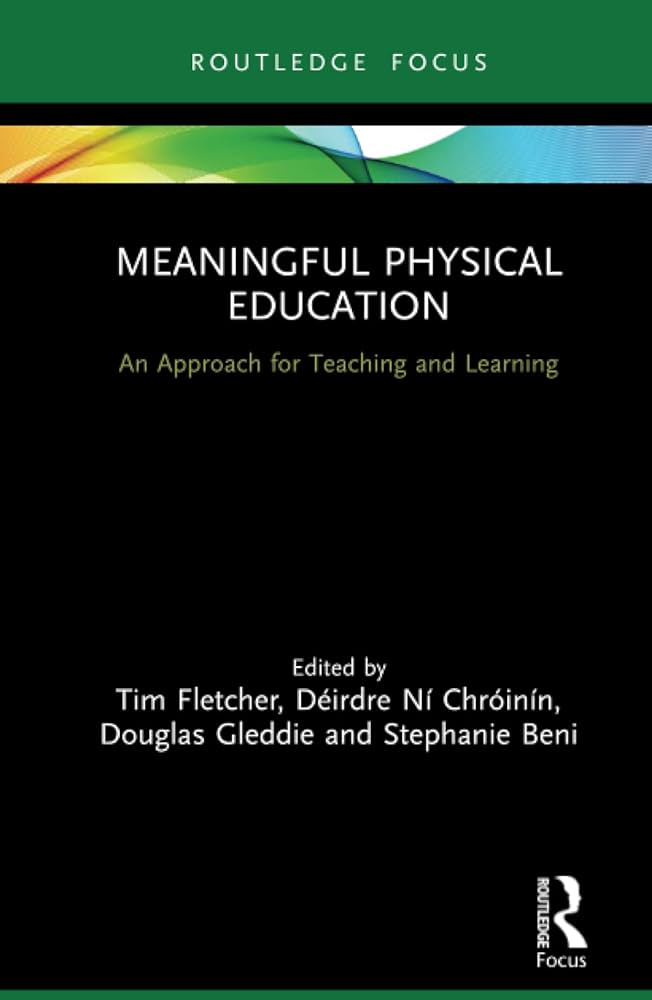
It will come as no surprise that the book that will continue to guide me and my teaching of PE over the coming year is Meaningful Physical Education from Tim Fletcher, Déirdre Ní Chróinín, Doug Gleddie, and Stephanie Benni. The theme of Meaningful PE is eloquently defined on page 4 of the book.
The primary theme of Meaningful PE is to support students in coming to value physical education through experiencing meaningfulness (i.e., interpreting an experience as having personal significance) and recognizing ways participation enhances the quality of their lives.
As a 29 year veteran teacher, I constantly strive to make learning experiences as meaningful as possible for my students. In physical education (we call it Kinetic Wellness at my school), this means going beyond simply teaching skills and sports—it’s about creating an environment where every student finds personal relevance, joy, and challenge in what they do. This year, I decided to take a proactive approach by asking my students to reflect on their past PE experiences at the start of the school year with this writing prompt:
Reflect on your past experiences in PE or any physical activities. What did you enjoy the most, and what made those moments stand out? Consider what makes an activity fun, challenging, or meaningful for you. What would a PE program need to include to ensure that every student has a positive experience and begins to appreciate the value of physical activity? Think about things like how activities are organized, who you get to work with, and how you feel when you’re participating.
My students don’t necessarily have the language of the Meaningful PE framework, but they do know what motivates them, what they find relevant, and what fills them with a sense of excitement, joy, and adventure rather than dread, boredom, or fear (Fletcher, Ní Chróinín, Gleddie, & Benni, 2021).
This assignment allows me to gather insights into what is personally significant to my students, helping me tailor my teaching to their interests, needs, and preferences. By understanding what my students find meaningful, I hope to design activities that are more relevant to them, increasing their engagement and the likelihood of them developing a lasting appreciation for physical activity.
We offer junior and senior students a significant number of PE electives at my school, ranging from dance to outdoor activities, yoga to strength and conditioning, team block to lifetime activities. The latter is my elective, a class that focuses on breadth more than depth, cooperation more than competition. I have a range of students from prospective D1 athletes to students yet to find a favorite way to move. Here is a summary of student responses to my prompt along with quotes.
Unsurprisingly, considering the cohort of students who choose this elective, there was much emphasis on the importance of teamwork, cooperation, and social interaction with friends. They valued working together, building connections, and ensuring that everyone feels included. The opportunity to socialize and engage with peers during activities was highlighted as a key element of a meaningful experience.
The most meaningful activities are when I get to spend time with people whose company I enjoy.
Making the class work together and create connections will ensure that every student has a positive experience.
Students appreciated activities that offered a ‘just-right’ level of challenge. They reported enjoying learning new skills and felt that overcoming challenges made the experience more rewarding. The desire for a balance in competition, where it was engaging but not overly intense, was also noted. Many students see their PE class a ‘break’ from academic stressors, and some identified that having sports practices after school meant that they didn’t want to work too hard in class.
The challenges I faced during PE, like learning new skills, made the experience more rewarding.
Competition will be ok if we’re with our friends and know not to take things too personally or seriously.
Fun was a central theme, with students repeatedly stating that enjoyable activities lead to a positive attitude toward physical activity. They mentioned that fun activities, especially when shared with friends, made PE meaningful and something they looked forward to.
The program should be fun. If students are enjoying themselves, they are more likely to develop a positive attitude towards physical activity.
It’s way more enjoyable when everyone is participating and engaged.
While the feature of motor competence wasn’t explicitly mentioned as other features, the importance of learning and improving physical skills was implied in the students’ desire to face challenges and learn new things. Students valued the opportunity to develop their abilities in a supportive environment, with a few students reminding me to give them the autonomy to modify lessons so that they could develop confidence and competence.
I want to learn new things so that we can all walk out of this class with lessons learned.
Students expressed a desire for activities that catered to their personal interests and needs. They appreciated when PE included a variety of activities that allowed them to find something they enjoyed, emphasizing the importance of personal relevance in making the experience meaningful. I do follow up with students later in the year with this written reflection that addresses personal relevance.
A PE program could get feedback from every student and see what activities the group as a whole enjoys most.
I enjoy my PE time because it gives me time to decompress and relax during a super stressful time.
Delight is the Meaningful PE feature that I still find the toughest to grasp, but it did spur me to write my first ever blog post about my journey towards embracing MPE. Delight was reflected in the joy students found in social interactions, fun activities, and the satisfaction of overcoming challenges. The positive emotions associated with these experiences contributed to the overall meaningfulness of PE for them.
I think what makes a good and meaningful experience in PE is having an environment where you feel you can be yourself and have fun with others.
I was impressed with the number of students who reported that they wanted an inclusive environment where all students felt safe, were respected, and felt seen and heard. Many students expressed a desire that I seek and incorporate their feedback and preferences, which in turn reminded me of Ty Riddick‘s recent blog post on the role of reflective practice in PE spaces.
Additionally, several students mentioned that PE provided a much-needed break from stress and an opportunity to clear their minds. Activities like walking, yoga, meditation and stretching were highlighted for their calming effects, offering a chance to decompress and relax.
As I move forward into the new school year, these reflections from my students will continue to shape the way I approach teaching PE. The insights they shared remind me that creating a meaningful experience in physical education goes beyond simply delivering content—it’s about fostering an environment where every student feels valued, challenged, and joyful. Guided by the principles of Meaningful PE, and inspired by the wisdom of my students, I’m excited to embark on another year of learning, growing, and finding delight in the journey together.
If this blog post has inspired you to read more on making PE more meaningful then you’ll like the following:
Meaningful PE: Autobiographical Assignment by Andy Milne
Making Meaningful Physical Education Elementary Friendly by Will Westphal
The Power of Meaningful and Joyful Experiences by Leticia Cariño
Buy the book! Meaningful Physical Education by Tim Fletcher, Déirdre Ní Chróinín, Doug Gleddie, and Stephanie Benni
Check out this Spotify playlist of podcast episodes discussing Meaningful PE, which includes the latest podcast project from Doug Gleddie and Ty Riddick.
 #slowchathealth
Pingback: Empowering Students: How I Led a PE Class Without Giving Instructions – #slowchathealth
Pingback: World Mental Health Day: Moving for a Healthier Mind – #slowchathealth