
Do you ever wonder if what you’re doing in the classroom is working? Is it actually having an impact on health behavior? In an attempt to ensure I was making a difference, I did some research into what actually works. That’s when I found out about the Social Norms Approach.
When employed, this approach has been shown to cause a statistically significant decrease in tobacco use, alcohol use and sexual risk taking. Most studies are of college students, but the Social Norms Approach has also been used effectively in middle schools and high schools.
What is the Social Norms Approach?
It’s pretty simple. Most teens overestimate how many of their peers are involved in health-risk behaviors. They think that most teens use drugs or have sex, when in reality, many of them don’t. The Social Norms Approach attempts to correct their normative beliefs. Here’s why…
If I believe that most of my peers vape, when I’m offered a vape (even if I don’t really want to), I’m more likely to vape.
Conversely, if I believe that most of my peers do NOT vape, when I’m offered a vape, I’m more likely NOT to vape (even if I do want to).
This approach takes advantage of the powerful influence peers have on adolescent behavior.
How can I use the Social Norms Approach?
First, you need to find data on actual teen behavior that your students will trust. The Youth Risk Behavior Survey and Monitoring the Future are both great resources. If your school participates in either survey – that’s the one to use. If you don’t, please, please, see if you can conduct the YRBS at your school (here’s the guide on how to do it). When your students have actually participated in the survey, it’s easier to get them to buy into the results.
Next, find out what students think. Have them guess how many teens use alcohol, vape, use marijuana, and have sex. Then, show them the survey data. No doubt, students will second-guess the results.
“People definitely lied on the survey,” they’ll say.
Ask them to consider if they lied or not and importantly, concede that some kids probably did lie. Some may have said they didn’t do things they actually do and others may have said they do things they actually don’t.
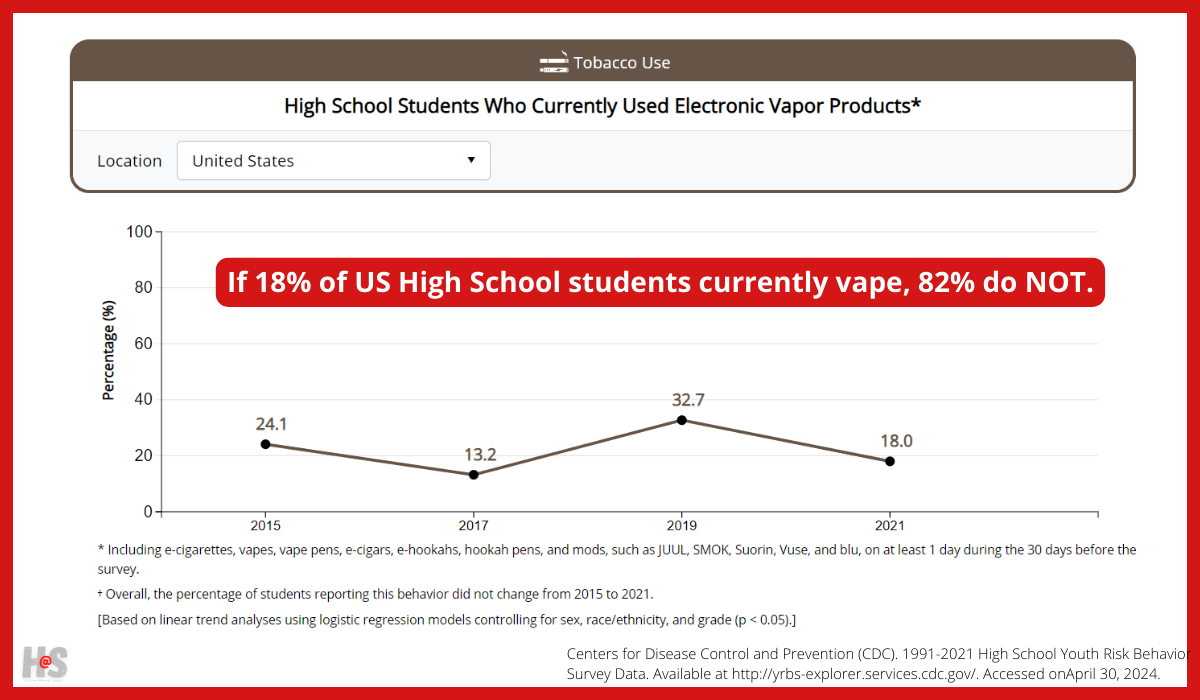
For example, the 2021 YRBS results show that 18% of high school teens currently vape (they vaped in the last 30 days). That means that 82% (the vast majority of teens) do NOT currently vape. Even if 20% of the students lied (that’s one in five of them), the percentage would be 38%. That means that 62% don’t vape – that’s still the majority.
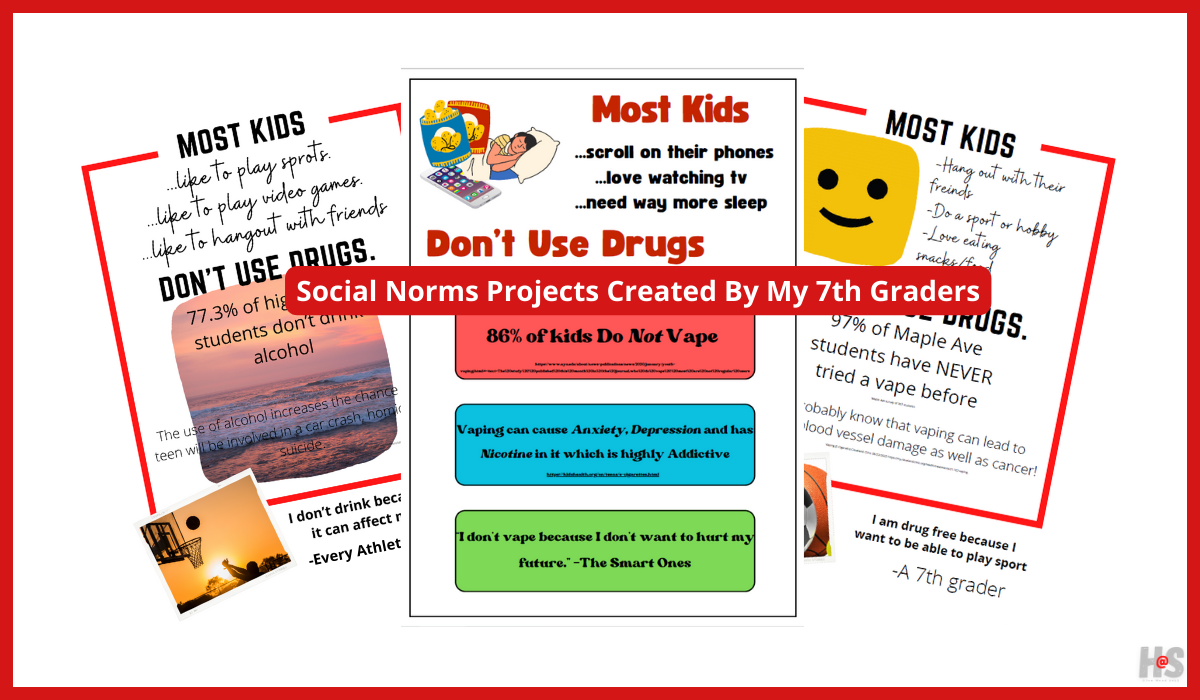
Lastly, find a way to advertise this to everyone at school, not just the students currently taking health class. I have my students create flyers where they flip the stat to the positive…82% of US teens do NOT vape (this normalizes the healthy behavior). I also have them include their personal reason for not vaping which helps personalize the message.
What do you do if a student does vape? I allow students to choose their topic when creating their flyer. This allows them to choose one of their behaviors that is consistent with the social norm.
Finally, we plaster their flyers everywhere we can…particularly the restrooms where they may actually take the time to read it.
Check out this free lesson to get started.
What standards will the Social Norms Approach meet?
SHAPE America Standard 2 and National Consensus for School Health Education Standard 2 (both are related to analyzing influences)
SHAPE America Standard 8 and National Consensus for School Health Education Standard 8 if you extend to a student project advertising the social norm (both are related to advocacy)
What else do I need to know about the Social Norms Approach?
While this approach has been shown effective, it is important that you choose the right time to use it. For example, if your local data reveals that the majority of students engage in a particular risk behavior, this is NOT the right approach.
Some of the research I did revealed that many campaigns that seek to raise awareness may normalize unsafe situations inadvertently. For example, sharing that as many as 65% of teens report being psychologically abused (in dating relationships), may make a student feel that the abuse they experience is normal. As a result, the teen may be less likely to seek support.
What resources support the use of the Social Norms Approach?
The National Social Norms Center at Michigan State University
Social Norms Approach: A Health Promotion Strategy to Preventing Youth Risk Behaviors. August 2022.
Behavioral Change Models: Social Norms Theory. November 2022.
The Social Norms Approach to Student Substance Abuse Prevention. September 2015.
What other strategies work?
I’ve researched a couple of other strategies that can actually make an impact on the health behavior of teens. To learn more, check out, Is it Working: Teaching Strategies for Health Education.
This microblog post was a featured post in #slowchathealth’s #microblogmonth event. You can search for all of the featured posts here. Please do follow each of the outstanding contributors on social media (including Jen Mead, the author of this post) and consider writing a microblog post of your own to be shared with the global audience of slowchathealth.com
You can also visit Jen’s website.
Pair this blog post with the following:
Create, Curate or Cart It? by Jen Mead
Using YRBS Data in #Healthed by Andy Milne
Building Your Health Curriculum by Amy Prior
My Lesson Has Crashed and Burned by LaDonda Porter
Have you read the latest Book of the Month recommendation?
 #slowchathealth
Pingback: Say My Name. Say My Name: Introducing The Teacher Multi-Tool – #slowchathealth