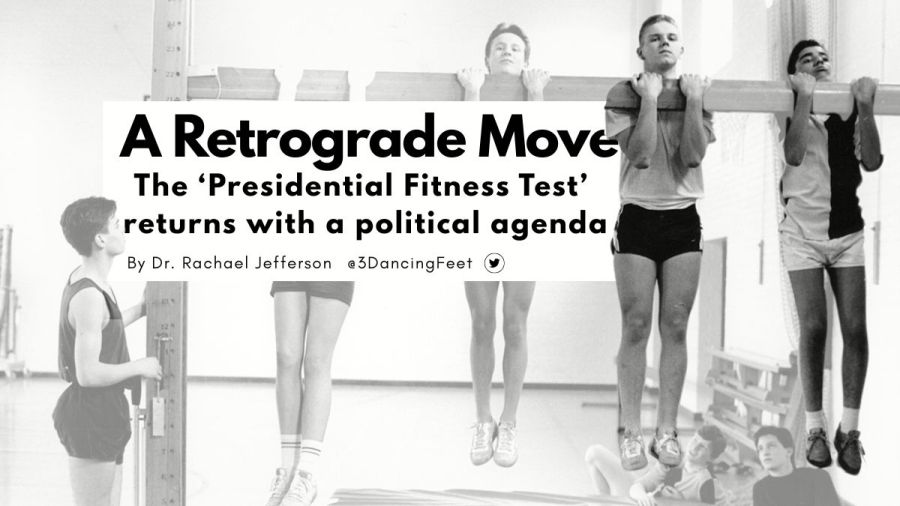
The White House has announced the revival of the Presidential Fitness Test (PFT), branding it as part of a renewed effort to promote active lifestyles, nutritious eating, and American sports in schools. Touting “bold and innovative fitness goals for young Americans”, the administration claims this proposal will help foster a healthier, more active generation. But in reality, the policy revives a Cold War-era fitness tool born from anxiety, not evidence – and one that is ill suited for today’s students and educational priorities.
Beneath its glossy veneer, the announcement quietly invokes “military readiness” – a stark reminder of the long-standing entanglement between physical education and militaristic agendas. This appears less like a progressive step for public health and more like a political manoeuvre dressed in activewear.
Origins of the PFT: Fear, not fitness
The roots of the PFT date back to the late 1950s, a period of rising national anxiety over American children’s fitness. Following Eisenhower’s creation of the President’s Council on Youth Fitness in 1956, the PFT was formally introduced by 1966. It was a direct response to comparative studies showing American children lagging behind their European peers in physical fitness.1
Far from being rooted in an understanding of child development, the PFT was shaped by Cold War concerns and international rivalry. It was never designed to nurture holistic, student-centred health; instead, it served as a symbol of national strength, projected through the bodies of children.
The problem with testing bodies
Fitness testing in U.S. schools has remained a staple since the 1950s, often used to monitor population health and national fitness trends. The PFT’s reinstatement might seem like an appeal to healthier lifestyles, yet the evidence supporting this approach is weak – and the developmental appropriateness is highly questionable.
- Physical education is not physical training anymore. Globally, children attend physical education just 2-3 times per week on average, which is far from enough to impact their fitness levels meaningfully. Even within these lessons, engagement in moderate to vigorous physical activity (MVPA) is often low (Kwon et al., 2020).
- Norm-based testing does not fit a diverse student population. The PFT benchmarks students against fixed standards, failing to account for the broad spectrum of physical, emotional, cognitive, and developmental differences between children. Many factors influence fitness test performances: health, fatigue, motivation, maturity, access to extracurricular activities, and more. Testing under uniform criteria risks alienating or shaming students who may be slower to develop or face additional challenges.
- It reinforces ableist and exclusionary norms. By rewarding only certain physical capabilities, such testing perpetuates a narrow vision of health and success, privileging athleticism while marginalising those who move or develop differently.
What does the research say?
- “The amount of time schools spend on fitness testing without necessarily positively influencing young people’s activity levels or their attitudes has been criticised and it has been suggested that PE time could be used more wisely” (Cale et al., 2006, p. 120).
- “Given the less than desirable participation in activity outside of school and the distressing prevalence of childhood overweight and obesity, it is unlikely that fitness testing experiences will provide children with much needed positive encouragement for lifelong physical activity” (Naughton et al., 2006, p. 40).
- Neoliberalism constructs society as a risk entity, in which individuals must self-monitor, and “where control of obesity and lifestyle disease is sought, bodies become symbols and sites for management and control” (Wrench & Garrett, 2008, p. 326).
- Fitness testing can do more harm than good when it comes to fostering long-term engagement in physical activity: ‘Fitness testing in physical education – a misdirected effort in promoting healthy lifestyles and physical activity?’ (Cale & Harris, 2009).
- Student voice needs to be centralised in contemporary physical education: ‘An expansive learning approach to transforming traditional fitness testing in health and physical education: student voice, feelings and hopes’ (Alfrey, 2023).
Toward a more student-centred approach: 5 takeaways
To genuinely support student wellbeing and foster meaningful engagement, fitness testing in schools must move away from rigid, standardised models. Instead, it should reflect inclusive, empowering approaches that honour each student’s individual development and lived experience.
As physical education teachers, we must:
1. explain the reliability and validity issues with testing children’s fitness levels, ensuring all testing processes are grounded in educating students and not training them;
2. frame assessments as tools for individual growth, helping students to monitor their own health and set personal goals;
3. offer student autonomy in all assessment processes in physical education.
4. NOT use fitness test results as the only measure of a student’s progress in physical education;
5. NOT use results to compare or rank students – this can undermine their confidence and motivation.
Final thoughts
The Presidential Fitness Test should remain a historical artefact, not a centrepiece of modern physical education. Its return signals a concerning focus on measurement and compliance over empowerment and inclusion. At a time when recess is being cut short in many U.S. schools, reintroducing a standardised fitness test seems tragically ironic. Is this really about “creating a national culture of strength, vitality, and excellence for the next generation” or about policing children’s bodies under the guise of health?
We owe our physical education students so much more than these dead-beat fitness policies and meaningless metrics.
Dr Rachael Jefferson, Senior Lecturer and Discipline Lead in Human Movement Studies (Physical Education, Health, Creative Arts)
Charles Sturt University, NSW, Australia
Facebook page ‘Physical Education, fundamental movement skills and holistic health’

1 Kraus, H. & R. P. Hirschland, R. P. (1953). Muscular fitness and health. Journal of Physical Education and Recreation, 24(10), 17–19. Kraus, H. & Hirschland, R. P. (1954). Minimum muscular fitness tests in school children. Research Quarterly 25, 178–188.
 #slowchathealth